

 Lillian Gipson and Kyle Jenkins, NASA
Advanced air mobility (AAM) is the collective term for next-generation aircraft that typically are highly automated, electrically powered, and capable of taking off and landing vertically. This emerging aviation sector offers new, cost-effective ways to move people and products, with potential applications ranging from air taxis to logistics and goods delivery, emergency response, and private and recreational use. As currently envisioned, the AAM ecosystem initially will rely on existing airports, heliports, and routes, but dedicated facilities and new routes are likely to be developed in the future.
As with any emerging technology, AAM has sparked excitement but also questions about its potential impacts and benefits. The airport industry, in particular, seeks to understand the role that facilities will play in accommodating AAM and the unique requirements of these aircraft. Likewise, communities want to ensure they’re included in the planning for AAM and its subset, urban air mobility (UAM), a rapidly evolving market characterized as the local, on-demand movement of people and goods, often using AAM technology.
Potential Uses
To help airports and communities thoughtfully and strategically prepare for AAM, TRB’s Airport Cooperative Research Program (ACRP) undertook two research studies aimed at providing an overview of the technologies and potential societal changes, along with practical guidelines and tools to assess and improve readiness. ACRP Research Report 243: Urban Air Mobility: An Airport Perspective provides a comprehensive examination of the emerging UAM industry, with a focus on its effects and opportunities for airports. ACRP Research Report 261: Advanced Air Mobility and Community Outreach: A Primer for Successful Stakeholder Engagement presents strategies and tools to encourage and promote engagement with airport operators and AAM operators, government agencies, and communities.
ACRP Research Report 243 and its accompanying toolkit seeks to inform airport industry practitioners who wish to explore the potential opportunities, benefits, and challenges of accommodating this new technology in an airport setting. The research, led by WSP USA, began with a state-of-practice review, focusing on the overall market, technology, regulatory and environmental considerations, and possible use cases. Next, the team conducted an airport-focused market assessment for the various use cases (Figure 1). The analysis and findings from the research were then used to prepare the report and develop a toolkit to help individual airports assess the potential and plan for UAM at their facility.
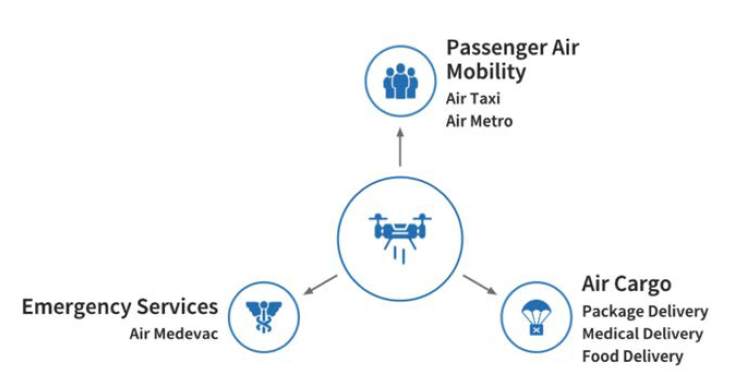
To understand the likelihood and magnitude of short- and long-term effects of UAM on the airport industry, the research focused on planning, public engagement, and the emergence of complementary technologies. Examples of these technologies include autonomous cars, shared mobility, and electrification of the aviation sector. UAM use cases explored such aspects as air metro service, similar to other transit modes; air cargo (particularly last-mile delivery); and air medical evacuation (likely replacing helicopters). The market for equipment, infrastructure, and other UAM activity for each use case was then estimated under low-, baseline-, and high-growth scenarios to explore potential challenges and opportunities for airports.
A key focus of ACRP Research Report 243 is to help airports develop strategies to integrate UAM into an airport setting by considering applicable policies and standards; facility, utility, and other infrastructure requirements; and corridor planning. The companion AAM Preparation Checklist and UAM Airport Assessment Toolkit enable airports to first assess their readiness for UAM activity and then help them make a go/no-go decision for investing resources to accommodate UAM based on market potential, community interest, capacity, resources, possible barriers, and risk mitigation.
ACRP Research Report 261 covers a broad spectrum of engagement issues. The report is designed for airport industry practitioners who wish to integrate stakeholder and community engagement into local planning efforts as AAM develops and evolves in their region.
The research, led by Mead & Hunt, began with a scan of current practice. This was followed by a significant outreach effort to collect input from key stakeholders and subject matter experts. A series of case studies were conducted to obtain greater understanding of emerging policies and practices pertaining to AAM, with a focus on safety, user acceptance, legal and regulatory issues, and stakeholder engagement.
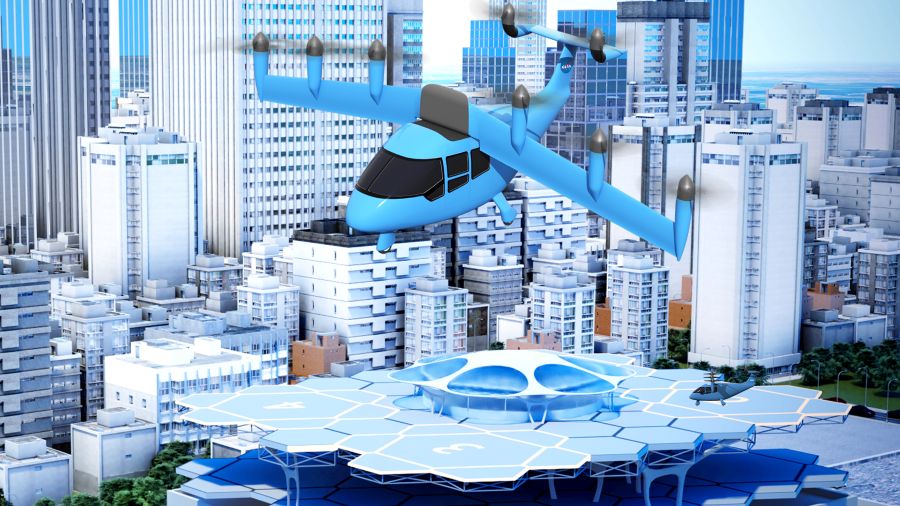
Vertiports are among the advanced air mobility infrastructure that NASA is researching.
ACRP Research Report 261 provides airport operators, public agencies, and other industry stakeholders with foundational information about AAM and its potential use cases and roles in communities. In addition, the primer includes a variety of stakeholder and community engagement materials that can be modified for local application. It also describes and provides suggestions for using the resources in an accompanying Stakeholder Engagement Toolkit. These additional resources include a roadmap, self-assessment survey, AAM fact sheet, slide presentation, event templates, and educational resources. Many of these resources are adaptable and scalable to allow airports to tailor them to their stakeholder and community needs throughout the planning, decision making, infrastructure development, and implementation of AAM operations.
Since AAM is a nascent innovation, considerable uncertainty remains with regard to its benefits and timing. Airport industry practitioners and stakeholders now have two ACRP research reports to guide their thoughtful planning and preparation for this promising technology.