
 Washington State DOT
I see a lot of wildlife as the Habitat Connectivity biologist in the Fish and Wildlife Program at the Washington State Department of Transportation. The mammals we observe can be as small as the American pika—a cute little animal from the rabbit family that resembles a large hamster—to massive elk and moose. My colleagues and I can usually identify the animals we monitor, even when captured on thermal videos.
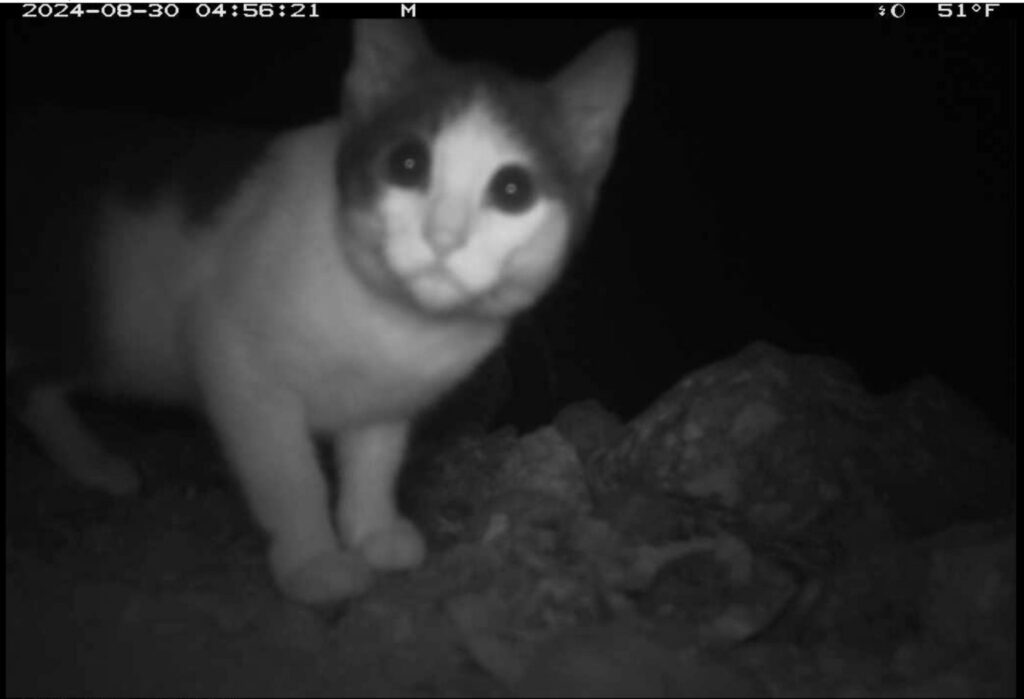
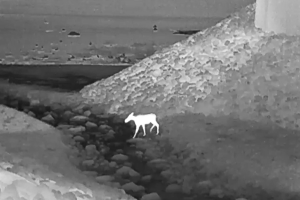
However, one night in early August 2024, we saw what looked like a bobcat kitten. It had a short, stubby tail and large paws relative to its small body. But we just weren’t sure. It was moving through the rocks at the Resort Creek Wildlife Underpass, the same structure where we witnessed the first moose ever documented in the South Cascades. We continued to observe the kitten over the next couple of weeks, including watching it scamper along the rocks with what may have been a pika in its jaws. However, after about three weeks, we realized that the kitten was not growing (which a bobcat kitten would do rapidly at that age), and it appeared to be successfully hunting (which a bobcat kitten wouldn’t do at that age). We also noticed that the kitten was never accompanied by its mother, which isn’t typical for a juvenile bobcat. Something was off, so we placed a trail camera to get a better look. Nearly a month passed between our first thermal camera detection and the close-up image we eventually captured (above). It wasn’t a bobcat at all, but a domestic kitten. That’s when we mounted a rescue mission for the cat I called “Moose.”
After the successful hunt of what may be an American pika, the kitten makes her way across the rocks to eat. (Washington State DOT)
Operation Kitten Capture
The Resort Creek Wildlife Underpass is about two-and-a-half hours from my house. I first set a large live trap under the bridge, along the route Moose frequented each night. I drove there every day for a week, baited the trap with tuna and wet food, and left it in a locked open position so it wouldn’t trigger the first few days. This was to get her comfortable with entering the trap to eat and maximize our chances of successfully capturing her. Each night, we watched Moose on the thermal camera as she arrived to eat around 8 p.m. Then she would disappear back into the rocks. However, the day before I armed the trap to catch her, she didn’t show up. I was very concerned that I had missed my window. This location is deep in the Cascade Mountains and, in addition to the 30,000 vehicles per day that pass overhead, many other things pose a real threat to a kitten.
On Friday, September 20, at roughly 7:30 p.m., I arrived once again to arm the trap. I then drove about 10 miles west to Snoqualmie Pass to wait. I had pointed a cellular trail camera at the trap, so I’d be alerted as soon as the door dropped. I expected to spend the whole night waiting, hoping that Moose would show up eventually. But within minutes of sitting down at a nearby restaurant and getting a coffee, the trap triggered. Moose was inside! It was dark by the time I returned, and parking is scant out there, so I walked about a quarter mile to reach the trap and got to work packing her up.
Protecting his hands and arms, as well as the trapped kitten, the author maintains his balance on slippery rocks to take Moose to the safety of his home. (Washington State DOT)
Off to a New Home
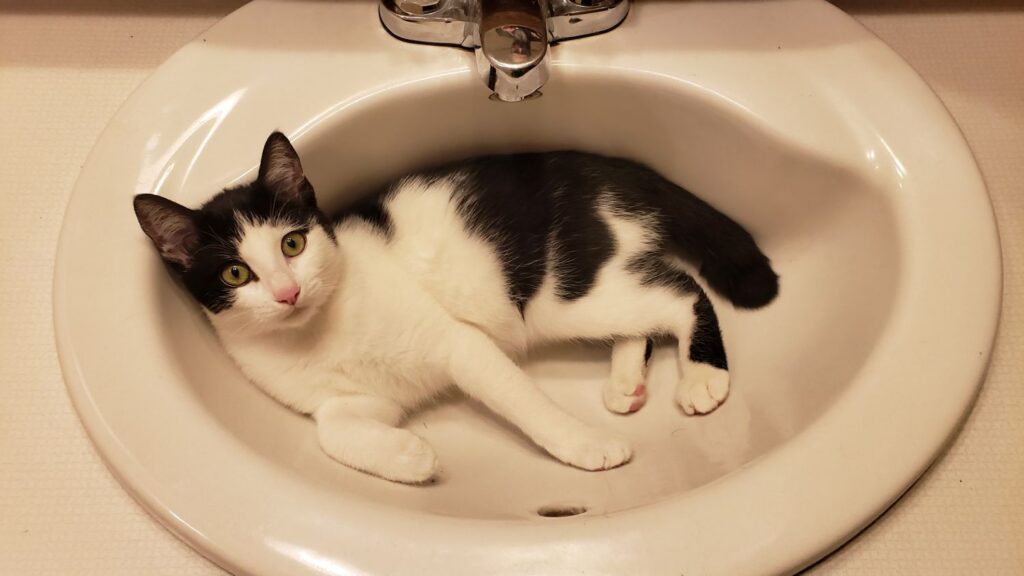
I thought Moose might be feral and wasn’t sure she’d adjust to living indoors. But I talked to her the whole way back home and off and on throughout the night. She remained silent. When I took her to the vet first thing Saturday morning, her care team were uncomfortable with letting her inside before getting a sense of her temperament. I led them to my car and reached into her crate to prove that she wasn’t vicious—not knowing the truth myself. She head-bumped my hand and purred slightly, the first sound she had made the entire time we had been in each other’s company. She received a clean bill of health, weighing in at 4.2 pounds.
 Glen Kalisz
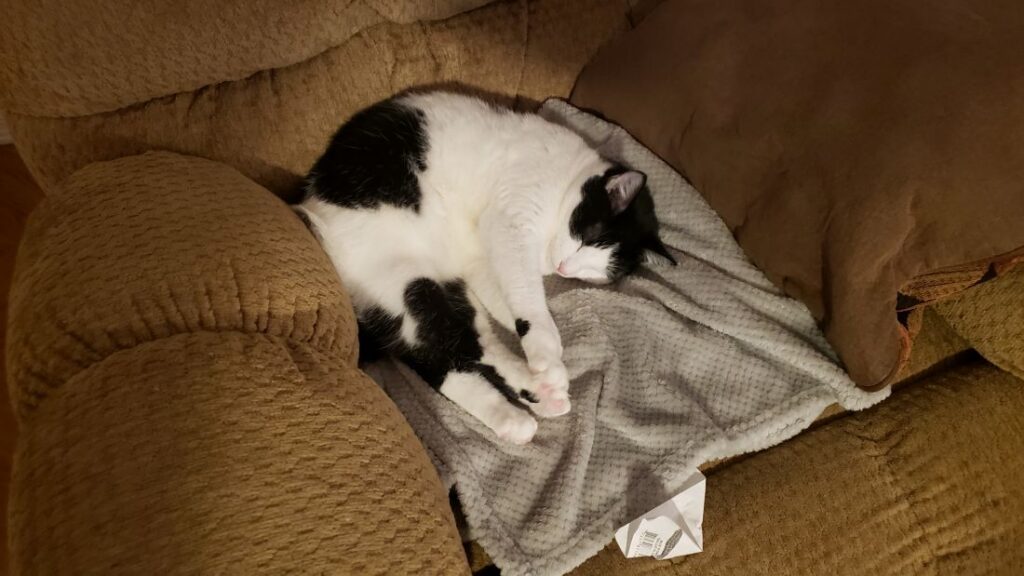
I brought Moose home and set her up in a small bedroom with an adjoining bathroom for the first month—just to make sure she’d adjust. She never once had an accident outside the litter box! It’s hard to believe that a recently trapped kitten that presumably lived under a bridge in the Cascade Mountains for most of her life was automatically litter-box trained!
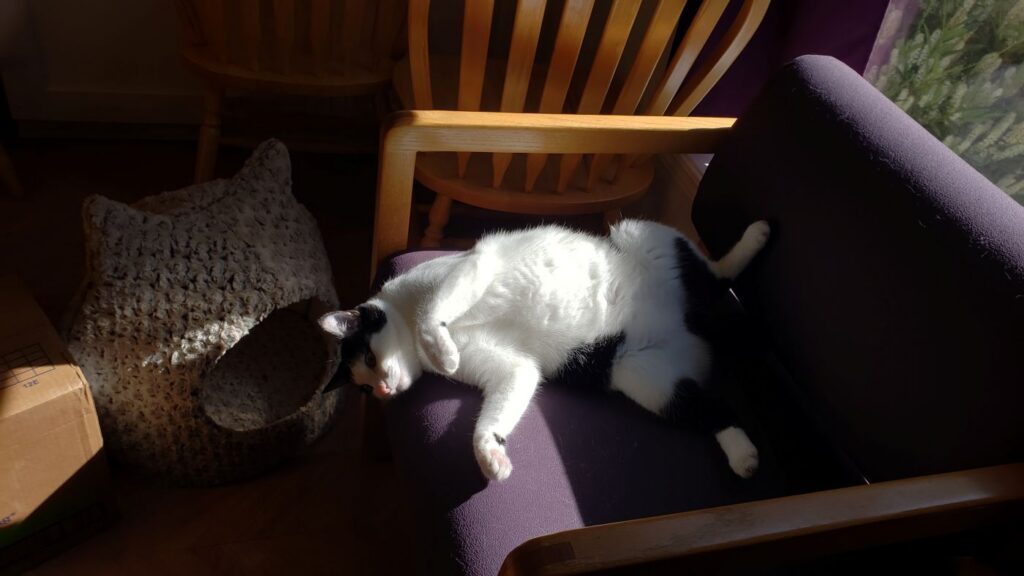
Moose warmed up to me quickly, although she doesn’t like being around other people. Now, we’re best friends. She loves to be carried around and sleeps in my bed at night. She often tugs at my pant leg, asking to be picked up, and she insists on crashing virtual meetings. No one minds. She has no interest in going outside and doesn’t seem to miss the daily grind of sharing a wildlife underpass with Pacific Northwest species.
The Resort Creek Wildlife Underpass is known for having American pika activity. They’re a sensitive species, and one of the many benefits of trapping and removing Moose from that location was to lessen her impact on native species. Of course, protecting her from the elements and larger animals, like the coyote mom that raised four pups in the exact structure soon after, was also of utmost importance.
The vet who saw her that September morning estimated that Moose was about 6 months old, which means she was born the previous March. We chose an exact date and celebrate her birthday on March 20, the first day of spring. She’s now a little over two years old and really enjoying the good life.
 Glen Kalisz
 Glen Kalisz
 Washington State DOT
Learn how careful planning of wildlife crossings in Washington State keep vehicle passengers safe and wildlife connected to valuable habitat.