
 Austin Transportation and Public Works
This article is partially derived and excerpted from NCHRP Research Report 1157: Strategies to Improve Pedestrian Safety at Night: A Guide.
More than 7,500 pedestrian were killed in the United States in 2022—an increase of 83 percent compared to a decades-long low in 2009. Roughly 75 percent of those deaths occurred in dark conditions, despite generally lower pedestrian activity during dark hours (1). These alarming trends spurred National Cooperative Highway Research Program (NCHRP) Project 17-97, “Strategies to Improve Pedestrian Safety at Night.” For this project, the study team investigated factors associated with pedestrian risk at night and developed guidance—NCHRP Research Report 1157: Strategies to Improve Pedestrian Safety at Night: A Guide—related to roadway design, operations, and policies to increase pedestrian safety.
The study included a comprehensive literature review and practitioner survey to understand the breadth of research related to pedestrian safety in darkness and how practitioners considered and acted to address conditions. The literature review and survey findings informed the original research, which included the following:
- A national analysis of pedestrian fatalities from 2010 to 2020;
- A multicity case-control study to understand factors associated with fatal and severe pedestrian injuries in darkness along high-risk roadways;
- Focus groups to understand driver and pedestrian behavior at night; and
- A driver simulation study to test the effects of lighting, speed, roadway and countermeasure design, and pedestrian skin color on driver detection of and reaction to people crossing the street.
These results were synthesized and reviewed through a series of practitioner interviews before being incorporated into Safe System Approach (SSA)–based design guidance specifically focused on improving pedestrian safety at night. Because vehicle speed is the primary mechanism for injury severity, NCHRP Research Report 1157 focuses on the Safe Speeds and Safe Roadways pillars of the SSA. It also provides information and strategies related to safe road users, safe vehicles, and post-crash care. The supporting NCHRP Web-Only Document 430: Improving Pedestrian Safety at Night provides information about the research behind the guidance. This article summarizes key findings from the research and the Safe Speeds and Safe Roadways pillars of the guidance.
Factors Affecting Pedestrian Risk in Darkness
Many interacting factors have contributed to the dramatic rise in pedestrian fatalities in darkness in the United States over the past 15 years. Figure 1 illustrates how these factors—which include increases in pedestrian exposure, risky behavior, and higher-risk vehicle design in contexts that have always been associated with higher traffic risk—interact to lead to increased risk for pedestrians, especially in darkness.
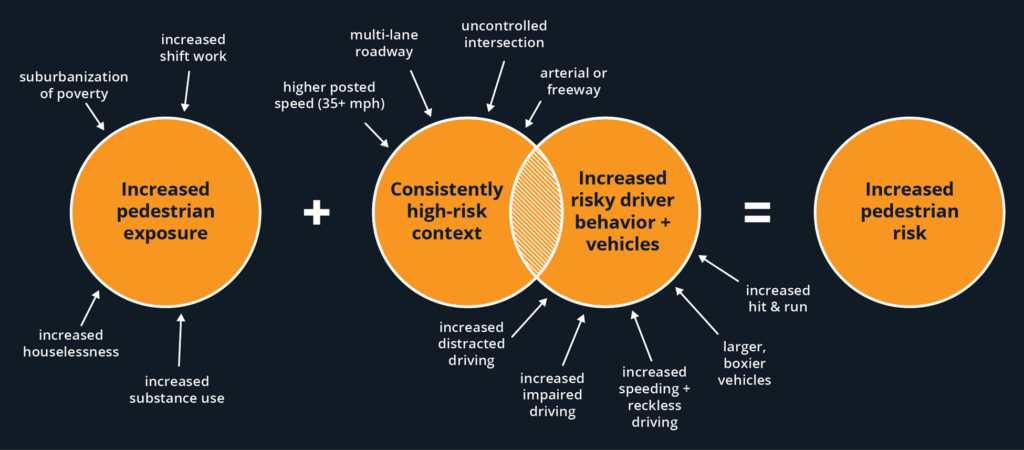
The guidance drew on FHWA’s Safe System Project–Based Alignment Framework to categorize these factors with regard to those that increase pedestrian exposure, likelihood of a crash, and potential for a severe outcome.
Because this project aimed to provide guidance on using roadway design and traffic control devices to improve safety at night, directly addressing many of the factors in Figure 1 was beyond the study team’s scope. Yet, much can be done within roadway design and operations—which interact with and influence the other factors in the figure—to encourage or discourage certain behaviors. For example, roadway design and operations play key roles in reducing vehicle speed and mitigating the likelihood of a crash or severe outcome with a higher-risk vehicle, as well as the degree to which a pedestrian is exposed to higher-risk circumstances—such as when working the late shift or when walking home while intoxicated.
The following synthesizes key findings from the team’s multimethod research and highlights from the related guidance:
Higher Roadway Speeds and Related Design and Operations Elements Create Consistent Pedestrian Risk
Roadway design and operations that prioritize speed and convenience significantly increase the risk of severe injury to pedestrians. These elements are clearly and disproportionately associated with pedestrian fatalities in general and, particularly so, after dark in urban and suburban areas (2, 3).
For example, wide, multilane roadways increase pedestrian risk by allowing for and encouraging high driver speeds (e.g., 35 miles per hour or more), carrying large amounts of vehicle traffic, and creating long crossings for pedestrians. These higher-speed roadways make it harder for drivers to detect a pedestrian and react in time to avoid a crash, particularly in dark conditions. Additionally, drivers often exceed posted speed limits on these high-speed roadways—particularly at night when there is less vehicular traffic to act as a deterrent and despite drivers’ inability to see as well, which further compounds pedestrian injury risk.
In addition to prioritizing driver speed, these corridors often have long distances between signalized intersections where drivers are required to stop. Such circumstances reduce drivers’ expectations of needing to stop or yield and decrease their awareness and ability to stop. These long distances force pedestrians to choose between walking—often blocks out of their way—to a marked crosswalk with supportive traffic control devices that feel safer or crossing at more convenient but higher-risk locations—such as unmarked intersection crosswalks or unsupported midblock crossings. Similarly, infrequent marked pedestrian crosswalks—particularly without supportive traffic control devices—that are midway along very long blocks and at unsignalized intersections on major thoroughfares increase pedestrian risk. These configurations allow for higher driver speeds and decreased driver expectation for encountering crossing pedestrians. A lack of safe, marked crosswalks is particularly harmful at locations where pedestrians should be expected and need to cross a roadway, including transit stops, parks, schools, and grocery and convenience stores—places that are often associated with pedestrian crash risk.
Humans Cannot See Well in Darkness, Significantly Increasing the Likelihood of a Crash at High Speeds
The negative impact of darkness on vision and visibility is a well-established fundamental risk to nighttime safety. Drivers receive approximately 90 percent of their information visually, a process that is substantially hindered in darkness (4). In a slow-moving setting, human eyes have more time to take in and process visual information. In addition, the slower speed means less reaction time is needed to prevent a tragic outcome. In contrast, drivers in high-speed environments need more time to process information while having less time to react, all the while increasing the kinetic energy and therefore the potential severity of a crash with each escalation in miles per hour. Mitigating the significant negative impact of darkness on drivers’ detection and reaction time (i.e., darkness impairment) is key to improving pedestrian safety at night.
The addition and evolution of vehicle headlights and streetlights over time are examples of efforts to address the darkness impairment. However, headlights and streetlights are often insufficient to mitigate darkness impairment at high speeds for several reasons related to detection–reaction time. With regard to detection time, drivers tend to focus directly in front of the vehicle—where their headlight beams shine—and, thus, may miss pedestrians approaching from the side, even in lit conditions (5). Additionally, humans cannot process as much peripheral information in darkness or at high speeds as they can in daylight or at low speeds. This interferes with the ability of drivers to detect pedestrians, even when roadway lighting is used. Both factors require drivers to have more time to detect a person who may be within a roadway or approaching a street to cross. Motorists operating at high speeds require longer distances to stop and, therefore, require more reaction time—and distance—to be able to stop a vehicle before a crash. High-speed environments communicate that drivers have the right of way and diminish driver expectation of pedestrians walking along or crossing these roadways. These lower driver expectations can then have the adverse effect of reducing potential detection–reaction time, even in lit conditions.
Roadway lighting is an important countermeasure to increase pedestrian visibility at night. However, lighting alone is generally insufficient to prevent pedestrian fatalities in the face of more auto-oriented, high-speed roadway design without other interventions that separate pedestrians from motorists and require drivers to stop for pedestrians when needed. In addition, roadway lighting that is sparsely placed, only on one side of the road, behind a crosswalk (leading to backlighting), or ill-suited for illuminating pedestrians may increase pedestrian risk by giving pedestrians and drivers the illusion that they can see and be seen by one another. Ideally, lighting should be scaled to the environment, provide sufficient coverage, and be supplemented with other countermeasures where needed so that pedestrians can be detected.
Understanding the Context Is Critical to Reducing Pedestrian Exposure to Risk
Increases in pedestrian activity in a low- or medium-risk downtown area, for example, may reduce risk on a per-capita basis, as demonstrated in the “safety in numbers” concept. However, high-risk, auto-oriented environments can be so challenging for walking that any increase in pedestrian activity in these areas tends to be associated with substantially increased pedestrian risk.
Yet, despite this known increase in risk, transportation planners and engineers have not consistently planned for pedestrian need, even near areas with moderate- or high-pedestrian activity. This disconnect can be seen in lower-income neighborhoods, communities that are disproportionately people of color, and for transit-dependent populations. Pedestrian burden and exposure increase when they must traverse long distances between safe, marked crossings; navigate complex intersection designs; and cross huge, multilane intersections built primarily to serve motorists and minimize their delay. Roadways with pedestrian-attracting land uses—especially transit service—can benefit from being designed or retrofitted for frequent, safe pedestrian access so that drivers and pedestrians can easily behave safely within the system. Failing to plan for daytime and nighttime pedestrian activity and expecting a person to walk or roll several blocks out of the way to access a safe pedestrian crossing perpetuate the harms and inequities of a transportation system built for motorist convenience and throughput rather than the needs of pedestrians.
Nighttime Behaviors Often Increase the Likelihood of a Crash
Alcohol and drug impairment, distraction, and reckless driving—all more common at night—negatively impact pedestrian and other roadway-user safety at night. In the past, these behaviors have primarily been addressed through education and enforcement measures, albeit with limited success outside of targeted campaigns, as evidenced by their continued prevalence as factors in traffic fatalities. A safe system will incorporate layers of mitigation, including robust transit services that provide alternatives to driving, as well as technologies such as intelligent speed assistance and ignition interlocks that protect roadway users from drivers’ harmful behaviors. Yet, a safe transportation system is resilient in the face of human mistakes, and roadway design and operations are critical to that resilience. Slow-speed environments discourage speeding and other reckless behaviors. Safe and convenient marked crosswalks in low-speed environments allow all pedestrians—including those who are intoxicated or struggling in other ways—to arrive safely at their destinations.
Applying the Safe System Approach to Increase Pedestrian Safety at Night
The guidance that evolved from the study team’s focus on safe roadways and safe speeds is centered around two key principles:
- Managing motorist speed is crucial to reducing kinetic energy and, therefore, the potential for injury severity; and
- Redressing the current and historic underinvestment that has led to disproportionate fatality risk for pedestrians in low-income underserved communities is critical to achieving a system that works for all.
To create a safer transportation system for all, transportation professionals can design for the most vulnerable roadway users in the most challenging of scenarios: walking at night. A safe system for pedestrians in darkness is one that meets the following goals:
- Vehicle speeds are managed to reduce the potential for a severe outcome;
- The likelihood of a crash is reduced through sufficient driver awareness of pedestrians in darkness—for this guidance, in particular—enhanced pedestrian visibility and drivers who yield are emphasized; and
- The time pedestrians are exposed to traffic in the roadway is limited.
To accomplish these goals, transportation professionals should consider incorporating as many countermeasures as needed to mitigate high-risk corridors and intersections through reconstruction, rapid implementation, and routine maintenance projects. Table 1 summarizes the countermeasures that the research suggests are effective for nighttime conditions, categorized by the countermeasure’s primary influence. Many countermeasures impact pedestrian risk in multiple ways, although no single countermeasure accomplishes all three goals. In particular, lighting is a critical countermeasure for improving nighttime safety. However, outside of low-speed, low-exposure environments, lighting alone is not sufficient to create a safe system for pedestrians in darkness. Furthermore, the appropriate application and combination of these countermeasures depend on context. The guidance provides information on countermeasure application and references the wealth of additional countermeasure options available to help practitioners make these decisions and create a safe system for pedestrians at night.
Table 1 Nighttime Countermeasures to Increase Pedestrian Safety
| Countermeasure | Pedestrian Risk Category | ||
| Manage Vehicular Speeds | Enhance Visibility | Reduce Pedestrian Exposure | |
| Road Reallocations | ✓ | * | |
| Speed Feedback Signs | ✓ | ||
| Automatic Speed Enforcement | ✓ | ||
| Lower Speed Limits | ✓ | ||
| Lighting | ✓ | ||
| Marked Crosswalks | ✓ | ||
| Traffic Signals | ✓ | ||
| Pedestrian Hybrid Beacons | ✓ | ||
| Rectangular Rapid-Flashing Beacons | ✓ | ||
| Daylighting/Curb Extensions | * | * | ✓ |
| Crossing Islands | * | ✓ | |
| Sidewalks, Walkways, Shared-Use Paths | * | * | ✓ |
Note: ✓ = primary pedestrian risk category for that countermeasure. * = secondary pedestrian risk category or categories.
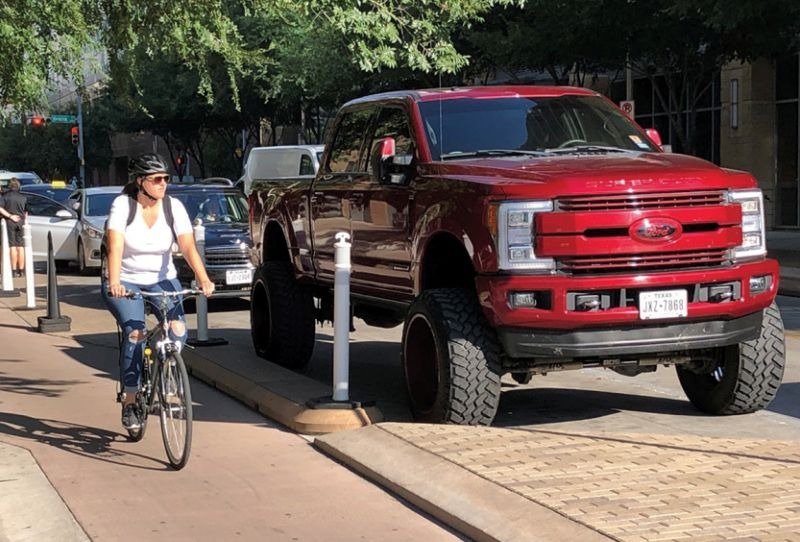
The guidance also includes information on employing countermeasures and policies to mitigate the harms of higher-risk vehicles, such as those that are larger, taller, or heavier—particularly with boxier hoods. Post-crash care includes considerations for emergency services planning, changes to transportation and land use planning policies, and suggestions for explicitly analyzing nighttime crashes in a project-specific and broader safety context.
 Bill Schultheiss, Toole Design
Conclusion
The research and guidance produced as part of NCHRP Research Report 1157 and NCHRP Web-Only Document 430 demonstrate that there are myriad actions across the SSA pillars that local, regional, state, and federal transportation and planning agencies can take now to create a holistic and systemic approach to improving pedestrian safety at night. The project team suggests that practitioners consider doing the following:
- Use proven and promising countermeasures and design principles to retrofit roadways to manage driver speeds during day and night conditions and reduce severe injury potential for pedestrians. To the degree possible, aim for self-enforcing roadways—such as those with speed bumps.
- Incorporate context-sensitive, consistent lighting to help drivers and pedestrians see each other when traveling at night.
- Design convenient, marked pedestrian crosswalks with supportive traffic control devices throughout the roadway system—particularly where pedestrian demand exists, such as at transit stops, schools, high-density housing, and grocery and convenience stores.
- Use intelligent speed assistance and community-informed automated speed enforcement wherever possible as a stopgap to manage speed on high-risk roadways, especially during lower-traffic nighttime conditions.
- Employ design and operational countermeasures to mitigate the harms caused by higher-risk vehicles.
- Encourage policymakers to evaluate and implement policies—such as weight taxes and fleet-purchasing strategies—to mitigate the harms caused by higher-risk vehicles.
- Study nighttime safety explicitly and incorporate insights back into design and policy practice so that the field is continuously improving.
- Employ an all-day, all-road users approach in traffic analyses to better represent the many roles and associated effects of roadways in a 24-hour transportation system.
- Strengthen the base of the Safe System Pyramid to the degree possible and through support for partner agencies that may be more directly involved in social services. For example, support the provision of network-wide transit and roadway design that is low risk for vulnerable populations, such as those experiencing houselessness or using impairing substances.
- Prioritize investments in neighborhoods that have not previously received high levels of funding for improving pedestrian safety at night.
Underlying all of these actions and strategies is the reality that local, regional, and state agencies can proactively make different choices from the past to effect different outcomes in the future. Significantly improving pedestrian safety on roadways is achievable if transportation practitioners are willing to use the suite of known safety countermeasures and effective policies already available.