
 Wikideas1, Wikimedia Commons, CC0 1.0
This article is partially derived and excerpted from NCHRP Research Report 998: Planning Freight-Efficient Land Uses: Methodology, Strategies, and Tools.
Transportation activity, land-use patterns, and the built environment are deeply interconnected. The need for freight transportation arises from the heterogeneity of planet Earth, where resources needed to support human life and societies—water, useful minerals, livable areas, and the like—are not uniformly distributed. Thus, supplies unavailable in one area require transportation from their original locations to where they are needed. In this context, the goal of National Cooperative Highway Research Program (NCHRP) Research Report 998: Planning Freight-Efficient Land Uses: Methodology, Strategies, and Tools is to help ensure that freight transportation and land use advance the economy, environment, and quality of life.
The key role of freight carriers is to transport supplies between the various stages of a supply chain: from raw materials locations to processing locations, manufacturing sites, distribution facilities, and all the way to consumers. In doing so, the resulting freight traffic produces large amounts of external effects, such as congestion, emissions, and infrastructure damage. Although it seems logical to blame the carriers for these externalities, close inspection reveals that carriers are not solely responsible for generating them.
The reality is that carriers rarely have full control of their operations, as they must follow their customers’ instructions or risk being fired. The agents who influence supply chains but do not participate in transportation (i.e., non-carrier agents) contribute to freight externalities in the following ways:
- Receivers typically decide on the number of deliveries and the corresponding time windows, which contribute to freight trip generation.
- City and state agencies, as well as the real estate sector control the availability and suitability of freight parking.
- Shippers and receivers decide where to locate, influencing vehicle miles traveled.
Using GPS data from supply chains in New York City, the research team responsible for National Cooperative Freight Research Program (NCFRP) Report 33: Improving Freight System Performance in Metropolitan Areas: A Planning Guide—published in 2015—computed the Shapley values to assess the role of non-carrier agents on the generation of externalities in urban freight. The research revealed that the distance between the stages of supply chains directly determines the amount of travel made by freight vehicles (i.e., freight vehicle miles traveled) on intercity highways, urban streets, and in metropolitan areas. Likewise, features of the built environment—such as a lack of off-street freight parking, loading docks, and freight elevators—affect freight operations and increase negative consequences.
Non-carrier agents make decisions based on business considerations and transportation and land-use policy regulations. The obligation of the transportation industry and land-use agencies is to create the conditions needed to lead non-carrier agents, as well as carriers, to make decisions that foster freight-efficient land uses (FELUs) and help advance the economy, environment, and communities’ quality of life.
NCHRP Research Report 998’s Goal and FELUs
The main goal of NCHRP Research Report 998 is to prepare transportation and land-use planners, designers, and practitioners to make transportation and land-use decisions that—step by step—lead to FELUs. To ensure a formal and unambiguous definition of FELUs, the research report adopted wording based on economic principles: FELUs are those land-use patterns that minimize the private and external costs associated with the production, transportation, and consumption of goods.
The private costs involve all the production–transportation–facility costs incurred by the business and infrastructure operators, such as labor costs and costs associated with the purchase and operation of equipment. The external costs refer to the effects on those who are not directly involved in such economic transactions. Though it is not always necessary, externalities may be translated into monetary values. However, consideration of all consequences—even qualitatively—is what really matters. There are important reasons to consider social costs, as not doing so can lead to land-use patterns that generate significant externalities that negatively impact local communities or that excessively penalize private-sector activity—to the detriment of the economy. Given the impossibility of rapid transformation of land uses, FELUs are an aspirational goal to be reached as part of a gradual process of improvement. By providing practitioners with the tools needed to analyze the freight efficiency of current and future land uses in their jurisdictions—and to identify and select land-use and transportation-related initiatives—NCHRP Research Report 998 offers practical insight into each stage of the planning process: from understanding the nature of the problem and its context to choosing a policy or planning solution to address the issue.
FELU Principles
To assist decision makers in the definition of effective FELU programs, NCHRP Research Report 998 identifies the following five basic principles that advance FELUs:
- Minimize the private and external costs of supply chains and their stages.
- Reduce the distance traveled at supply chain stages—upstream and downstream.
- Mitigate or eliminate the externalities at supply chain nodes and large traffic generators.
- Recognize and account for local conditions.
- Proactively engage all stakeholders (1).
Principle 1 asserts that land-use planning should consider the consequences of land-use decisions across all supply chains, as only focusing on the effects at specific locations could lead to significant unintended outcomes.
Principle 2 provides a pragmatic and robust rule that operationalizes the FELU decision-making process. The gradual implementation of this rule results in more compact and efficient supply chains.
Principle 3 reflects the social and economic imperative of ensuring that large traffic generators (e.g., distribution centers and ports) do not impact surrounding communities.
Principle 4 explicitly states the importance of context-appropriate and context-sensitive FELU initiatives.
Finally, Principle 5 recognizes the importance of participatory exercises to ensure that all involved contribute to the development of sound land-use planning and policy.
To help achieve the vision encapsulated in these principles, the team developed a comprehensive catalog of public-sector land-use and transportation initiatives, including projects, programs, and policies. To this effect, the team updated the transportation initiatives from NCFRP Report 33 and added the land-use initiatives relevant to FELUs. To help practitioners, the research team developed an initiative selector that allows users to specify the problem of interest, yielding a list of one-pagers summarizing potential initiatives. Ultimately, the application of these principles leads to compact supply chains that are woven into the fabric of rural and metropolitan areas.
 Preston Keres, USDA, Flickr, PDM 1.0
Transportation and Land-Use Initiatives
Developing tools and recommendations that apply to a wide variety of agencies and regions is a challenging task. The heterogeneity in land-use patterns, economic conditions, and government structures across the United States should be considered.
For the local context, the project team developed tools and methods to evaluate existing conditions unique to local areas and to understand how these conditions influence freight mobility. The methods rely on publicly available data, allowing the tools to be more accessible to practitioners who seek to understand the geographic distribution of freight activity and the separation between key stages of the supply chain.
These initiatives—as laid out in NCHRP Research Report 998—are not only limited to those that alter land uses but also include complementary transportation initiatives that support freight-efficient operations. More often than not, the implementation of land-use initiatives is facilitated by the deployment of complementary transportation initiatives and vice versa. For instance, community opposition to the installation of an urban distribution center for concerns over night noise could be mitigated with the deployment of low-noise transportation practices such as off-hour deliveries.
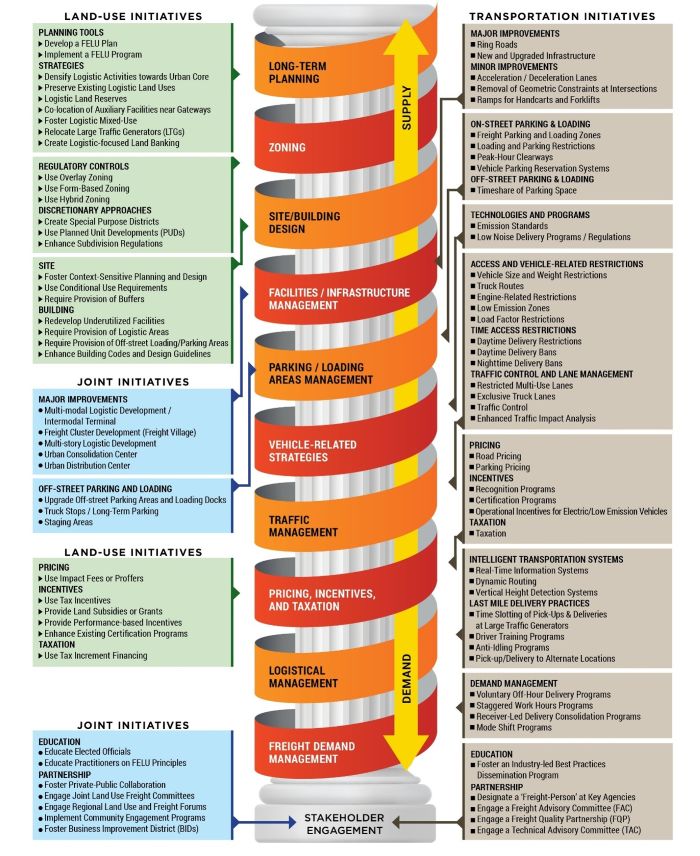
The initiatives were identified based on more than 300 sources of literature reviews, academic and practitioner knowledge, and discussions with public- and private-sector stakeholders. Forty-three initiatives related to land use and 61 transportation-related initiatives were categorized into several major groups, as shown in Figure 1.
Freight-Efficient Land-Use Strategy
Achieving FELUs is complex. The most effective approaches will likely involve multiple initiatives working in combination to address specific issues. Step by step, the comprehensive use of FELU initiatives is bound to increase the efficiency of supply chains and foster the smooth integration of freight activity into the fabric of communities and the economy.
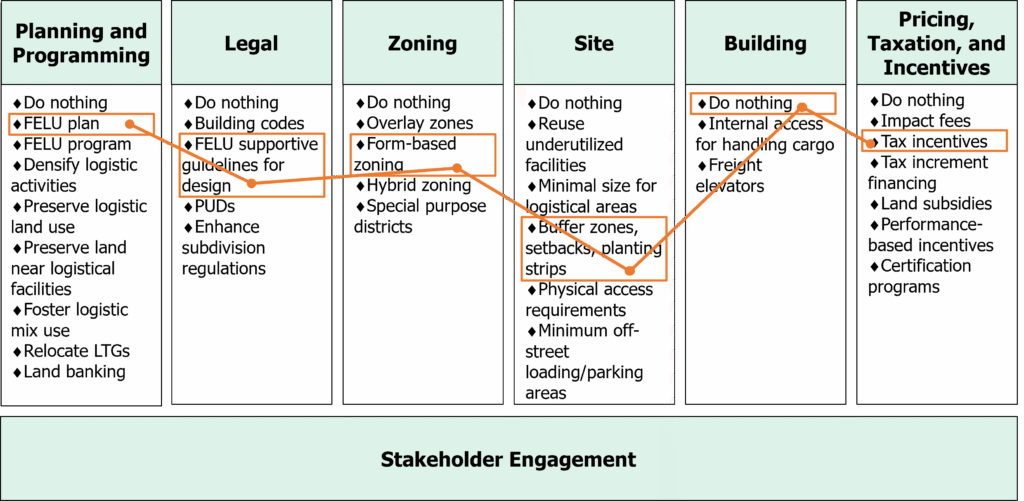
NCHRP Research Report 998 discusses the use of complementary initiatives in two ways. The first way entails combinations of land-use initiatives that are within the control of land-use agencies. Figure 2 shows an example of potential combinations of initiatives as a line connecting the initiatives from different groups.
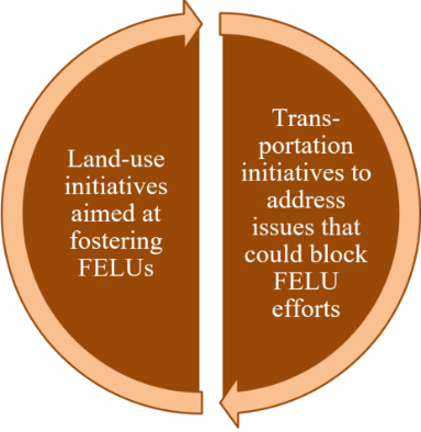
The second way to combine initiatives seeks to take advantage of land-use and transportation initiatives (Figure 3). Tapping into the arsenal of initiatives available to land-use and transportation agencies gives these joint efforts tremendous power, as they could complement each other.
In this context, consider the following:
- Land-use initiatives can be used to facilitate changes in zoning, buildings, sites, and the nature of the activities that could be performed at the site.
- Transportation-related initiatives would mitigate or eliminate the negative effects on local communities that could jeopardize the implementation of land-use initiatives to foster FELUs.
The holistic application of land-use and transportation initiatives enables land-use and transportation planners to exploit the synergistic elements among these initiatives, increasing the effectiveness of the entire effort. By using this holistic strategy, for instance, community concerns about the noise produced at an urban distribution center could also be addressed by requiring the operator to use electric vehicles and low-noise equipment to bring supplies to the distribution center and then use electric cargo bikes to make deliveries.
Long-Term Planning
The following numbered initiatives represent high-level strategies, policies, programs, and projects that set the foundation to foster FELUs in the long term. Taken together, they provide a wide range of potential avenues for movement toward FELUs in ways that acknowledge the local economic and land-use conditions, as well as the institutional settings governing land-use planning and policy.
Initiative LU1: Develop a FELU Plan
A FELU plan aims to reduce systematic inefficiencies in the supply chain—such as vehicle miles traveled—to control logistic sprawl and reduce livability issues between freight traffic/facilities and other agents, such as pedestrians. An example of best practice is Paris, France, where three regional master plans were developed to foster FELUs: the General Master Plan (2013–2030), the Transportation Master Plan (2014–2020), and the Climate, Energy, and Air Master Plan (2012–2020/2050). These plans include land reserved for freight infrastructure and redevelopment in the metropolitan area, which allow the interaction between logistic-intensive land uses and other land uses. In addition, there are already several potential areas selected in which industrial densification would be encouraged. These selected locations also have the potential to use waterways as an alternative to road transportation.
Initiative LU2: Implement a FELU Program
This initiative aims to create a program that facilitates the gradual implementation of projects in the FELU plan. The program acts as the roadmap for policy planners to achieve a systematic implementation of the initiatives typically outlined in a FELU plan. The FELU plan acts as the master plan. However, the FELU program is the implementation plan for policy planners to achieve the goals proposed in the plan. Although it is not necessary to use a FELU plan and develop a FELU program based on it, policy planners prefer to do so. These initiatives aim to holistically consider all of the stakeholders who are affected and identify and prioritize the initiatives to be implemented during a specific time period.
Implementation of any FELU plan must be intertwined with ongoing initiatives to enhance stakeholder engagement. For successful plan implementation, it is critical to engage government agencies, developers, building and streetscape designers, and freight carriers throughout the process.
Initiative LU3: Increase Density of Logistic Activities Toward the Urban Core
With more logistic space provided near the urban core, transportation of goods can be more efficient. This results in fewer externalities, mainly through the reduction of freight vehicle miles traveled. The benefits of the increased sustainability attributed to freight activity and improved traffic dynamics include reducing double parking or the search for parking. In addition, more sustainable modes of transportation—such as electric vans or cargo bikes—can be used for the last leg of deliveries from the urban distribution center to the receiver.
In Paris, recent concerns about regional air quality have encouraged the desire to reduce the distance large freight vehicles need to travel through the city. (Other proposed initiatives—such as low-emissions zones that help sustain the status quo—have experienced little success). The city has moved to reintroduce logistic facilities within its boundaries. The latest Paris zoning plan accommodates logistic facilities in several neighborhoods. This has allowed carriers to use smaller and more energy-efficient vehicles, as well as reduce the distance and number of freight trips to businesses. For example, the Beaugrenelle logistics hotel is a former parking lot in a high-density, commercial area of Paris. It was repurposed for the daily processing of up to 6,500 parcels (less than 30 kilograms each). At the time, the redistribution from the logistics hotel to consumers was done by 30 electric Euro 6 vehicles (L. Dablanc, personal communication, Oct. 12, 2015).
Initiative LU4: Preserve Existing Logistic Land Uses
The urban space is a dynamic environment. Population growth and economic fluctuations, for example, could trigger changes in the demand for land in urban and metropolitan areas. Thus, it is important to avoid logistic sprawl by preserving existing logistic facilities and land uses. The preservation of such areas can be done by explicitly restricting zoning for land uses other than logistical. For instance, the Maryland Port Authority designated the port and maritime industry areas as a special-purpose district. This prevents the conversion of the land to nonindustrial uses. Similarly, the American Planning Association promotes special districts and performance zoning for agricultural land preservation. Such districts or zones aim at limiting nonagricultural development to densities and development patterns that are consistent with local agricultural activity.
One of the main challenges to implementing this initiative is finding agreement between multiple stakeholders who might have conflicting interests regarding the use of the land. For example, the City of Seattle and King County in Washington developed a memorandum of understanding about the construction of a basketball arena in an industrial district as part of an effort to expand the stadium district, which already had a baseball stadium. However, the city government was concerned that the new basketball arena would create demand for complementary facilities—such as restaurants and hotels—in the surrounding areas. Such development would force the industrial facilities located in the area to move, negatively impacting the city’s economy. With the memorandum of understanding, Seattle and King County reached an agreement to zone the land near the new arena for industrial use only as a way to preserve the industrial district.
Initiative LU5: Logistic Land Reserves
Logistical facilities, such as distribution centers and manufacturing sites, might require additional space to expand as demand grows. If that space is not available, these facilities are relocated away from the urban core where space is not a concern. As the city grows, however, land availability and cost become an obstacle for the expansion and maintenance of logistical facilities, which are then pushed further away from the urban core as logistic sprawl. By reserving the land near existing facilities, it is possible to prevent these areas from developing land uses that are not compatible with industrial or logistical activities, and therefore, avoid logistic sprawl.
Initiative LU6: Co-Location of Auxiliary Facilities Near Major Gateways
Gateways such as ports and rail terminals require auxiliary facilities for their operations. For example, ports require container yards, truck terminals, and chassis pools. If these auxiliary facilities are conveniently located close to the port, freight vehicles do not have to travel long distances to access them. This reduces total vehicle miles traveled and externalities—such as congestion and pollution—caused by vehicle traffic. The Port of Yokohama on Japan’s Tokyo Bay was planned with all auxiliary facilities close to the piers. This initiative has helped the port become one of the major maritime gateways not only of the Tokyo metropolitan area but also of Japan as a whole.
Initiative LU7: Foster Logistic Mixed Use
Mixed land uses are a fundamental element in land-use ordinances to prevent and reduce externalities caused by transportation. Land-use planners take advantage of such factors by locating complementary land uses in the same area, such as residential and commercial. This initiative aims to foster the mixture of traditional (e.g., residential and commercial) and logistic land uses in metropolitan areas. Allocation of logistic land use in urban areas results in shorter vehicle miles traveled and reduced emissions and logistic sprawl. If done correctly, a proper balance is obtained in which an urban site allows for logistical, commercial, and retail activities.
In Paris, the Chapelle International logistics hotel—located on the north side of the city—consists of an urban rail terminal, a delivery center, residential units, a fitness center, offices, restaurants, and sports fields and an urban agricultural farm on the roof. It also includes two training centers for the national business school, retail space with underground parking, a data center that hosts Paris City Hall’s servers, and a heat-producing center for heating the district. With such amenities immediately available to the facility’s residents, daily truck trips and emissions are reduced significantly.
Initiative LU8: Relocate Large Traffic Generators, If Warranted
Relocating large traffic generators could—under proper circumstances—be a valid alternative to reduce some of the effects produced by operating these facilities. Such relocations require careful consideration of any potential unintended consequences. Although it is common for local communities to favor the relocation of large traffic generators, experience has shown that relocation may, in fact, increase congestion.
Because of land costs, regulations, and traffic conditions, many cities have experienced logistic sprawl during the past several decades. For example, the original South Water Market in Chicago, Illinois, was constructed when horse-drawn vehicles brought produce to market and evolved as trucks were introduced. Over time, as trucks grew in size, the efficiency of the market declined. In an effort to improve conditions, the market was relocated to the new Chicago International Produce Market, a few miles farther west from the old location. Ultimately, the new and more spacious facility could manage the freight-vehicle traffic in the zone more effectively.
Initiative LU9: Create Logistics-Focused Land Banking
The main intent of land banking is to save small tracts of land so that, in the future, they could be put together to execute logistic projects that foster FELUs or traded for other parcels of land that could advance them. The effective use of land in urban areas is critical to achieving an efficient transportation and supply chain operation. This initiative aims at converting vacant, abandoned, and tax delinquent properties for logistical uses. If done correctly, a reduction of vehicle miles traveled will occur. In addition, this initiative increases the efficiency of urban logistic activities—by promoting shorter freight trips, as well as reducing the number of vehicle miles traveled—and fosters a more compact urban form.
Taken together, the insights discussed in this article emphasize the need to deploy holistic approaches involving transportation and land-use initiatives that are expected to produce beneficial impacts at different time horizons—from short to long term. This is essential to improve freight efficiency in the short term and make the work of planners and decision makers easier in the future.