

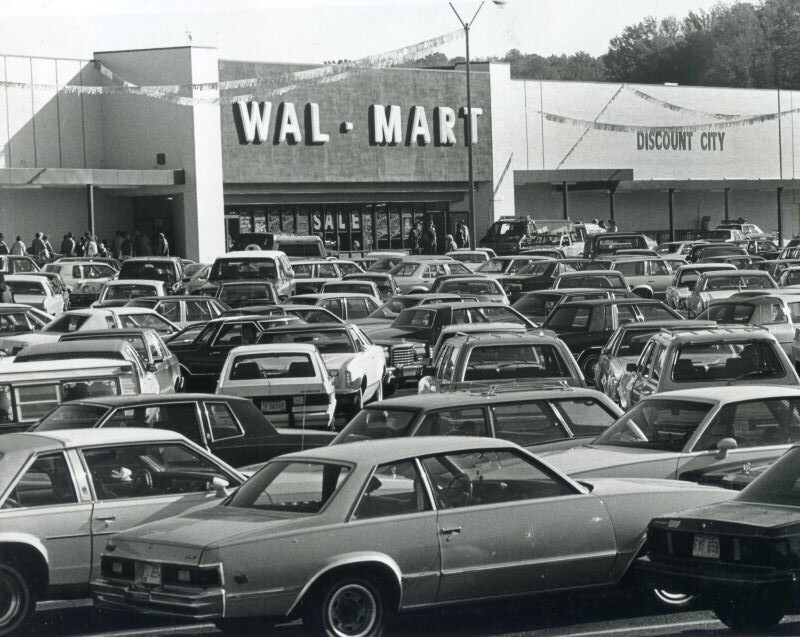
 Phillip Pessar, Flickr, CC BY 2.0
Travel behavior—particularly the extent of people making trips—has changed markedly since the turn of the 21st Century, responding to changes in technology, the economy, demographics, and people’s values and personal behaviors. This has resulted in significant changes in travel demand: The number of people and products that need to get from one place to another via various modes of transportation. However, the consequences of those changes have yet to be fully appreciated and integrated into transportation planning, policy, and investment decision making. This article presents an analysis of the changes, with observations on their implications for transportation planning going forward.
The Evolution of Travel Behavior
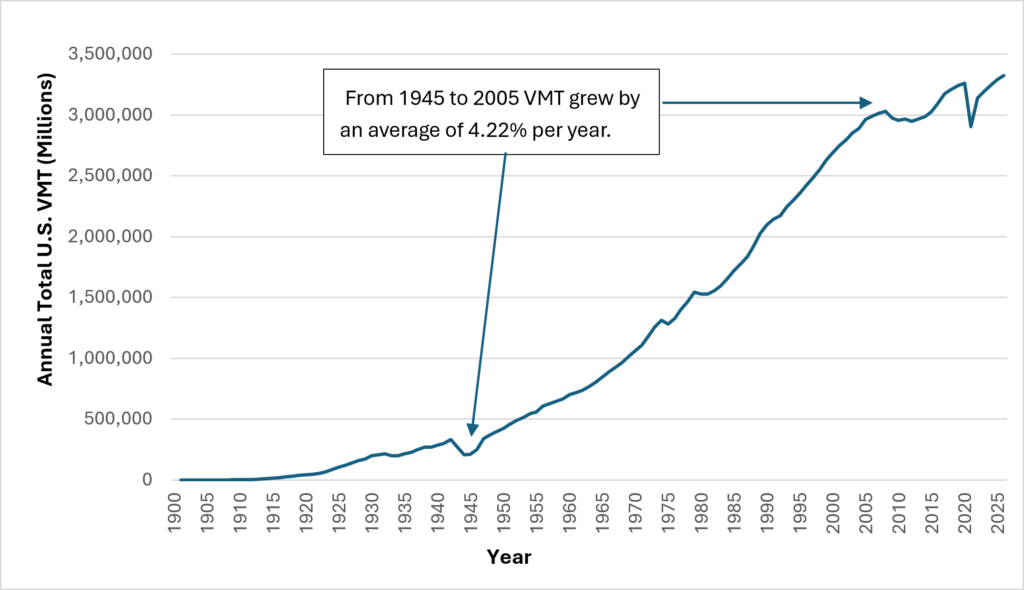
Most of the planning processes and methods that have guided the evolution of transportation systems were developed in the decades after World War II. While the signature event was the creation of the Interstate highway system, which began in 1956 (1), this period was characterized by expanded urbanization and suburbanization, rapid increases in automobile availability, growing female labor force participation, and specialization in people’s activities as services and products evolved to accommodate the accelerating economy. Household incomes rose, homes got larger and more dispersed, and household sizes shrank (2). Between 1945 and 2005, vehicle miles traveled increased by 4.22 percent per year on average, as shown in Figure 1.
During this era, U.S. industries consolidated and business models evolved to capture economies of scale and agglomeration. Labor specialization resulted in the evolution of global supply chains as significant shares of manufacturing were outsourced. Consolidation affected industries ranging from family farms and gas stations to hospitals and banks. Grocery stores grew to tens of thousands of square feet and began stocking other retail items. As the lifestyles of multi-earner families and the economics of businesses changed, activities were no longer centered in the community. People liked the convenience, economy, and choices between dozens of attractively priced products that large-scale retailers afforded. (See Roadside Relics: Preserving Postwar Commercial Properties in TR News 350.)
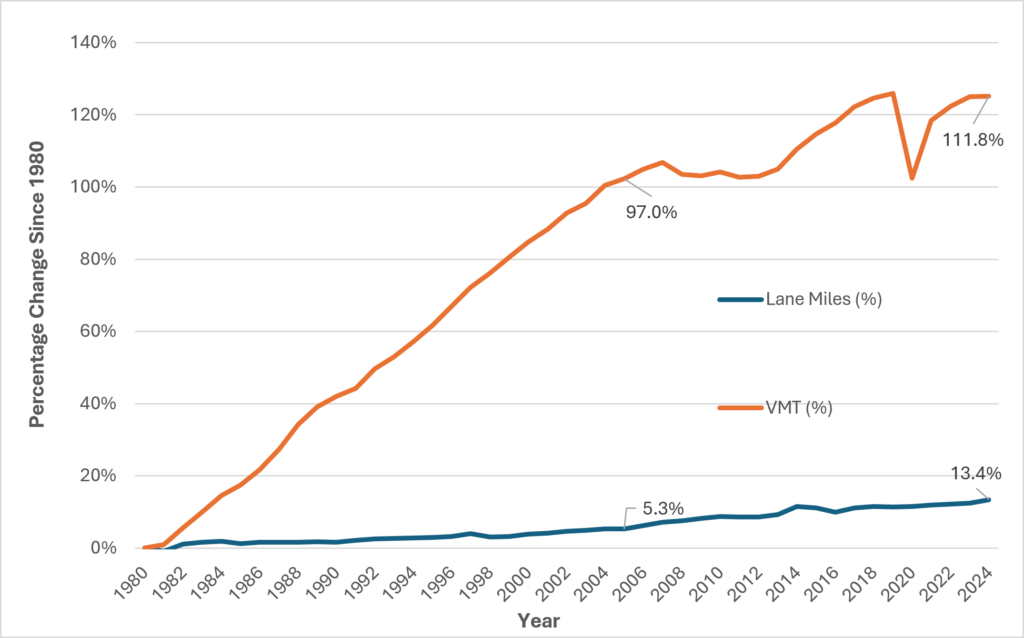
Forecasting growing demand was relatively easy. Meeting demand was not. As shown in Figure 2, lane miles failed to keep pace with the growth in travel.
The Influence of Technology
As the United States approached the 21st Century, the deployment of technology that would affect transportation began to increase dramatically. The emergence of information and communication technologies enabled digital communications to replace in-person presence and altered multiple aspects of travel—from sophisticated logistics that optimized freight movements to meaningful improvements in the comfort and convenience of accomplishing household tasks. Although communication and computing technologies progressed during the 1960s, ’70s, and ’80s, they began to have a significant impact on travel in the 1990s.
The 1990s also marked the rise of the World Wide Web, enabling global connectivity and services. In 1994, the first secure online transaction was completed, with Pizza Hut offering online ordering (3). In 1995, Amazon and eBay debuted, pioneering business-to-consumer and consumer-to-consumer commerce (4, 5). And the first Google search took place in 1998 (6). All represented an uptick in online food ordering, holiday shopping, and research without trips to restaurants, retail stores, or libraries, respectively.
The early 2000s saw the birth of social networks. MySpace popularized online social circles, LinkedIn focused on professional networking, and Facebook—launched in 2004—became an emerging global hub for personal connections (7). YouTube revolutionized video sharing, and Apple introduced the iPhone in 2007 (8). Social media platforms such as Twitter (i.e., X), Instagram, Snapchat, and TikTok became household names over succeeding years.
In addition to the social engagement enabled by enhanced communications capabilities, online e-commerce began transforming the way businesses and consumers interact, evolving into a global digital marketplace powered by mobile technology. E-commerce, as measured in share of expenditures, grew from less than 1 percent in 2000 to 16.9 percent by the end of 2025, surpassing its COVID-19 peak on its upward trend (9). The future promises more innovation with augmented reality shopping and AI-powered recommendations.
 TRB Staff
The workplace changed, as well. Online communications enabled remote meetings and distance learning, and conferencing gained stride as network speeds and software capabilities improved. Continuing technology enhancements—coupled with the outbreak of COVID-19 in 2020—dramatically transformed commuting. Teleworking skyrocketed from levels well under 10 percent of workers to a majority at the height of the pandemic (C. G. Aksoy, J. M. Barrero, N. Bloom, S. J. Davis, M. Dolls, and P. Zarate, unpublished work, 2025). Zoom, launched in January 2013, surged as a reliable videoconferencing solution (10). COVID-19 drove the explosive adoption of the technology with daily meeting participants jumping to 300 million in April 2020 (11). As the virus’ deadly effects waned, daily teleworking moderated but remains at approximately 25 percent for employed workers (12).
Access to the Internet with smartphones and computing devices reached a greater market penetration of households than did automobile availability. Various surveys show Americans spend from seven to 10 or more hours on screens daily, diminishing the time available and need for as much travel as in the past (13, 14).
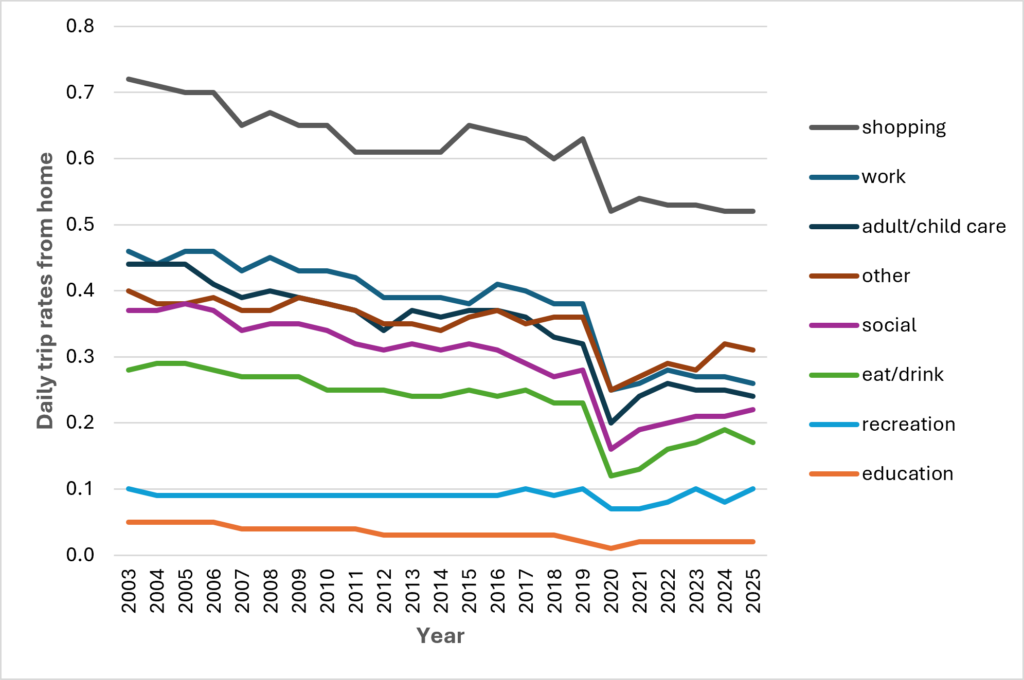
Data confirm the decline in trip making. The American Time Use Survey reported that 2025 daily per capita trip rates for respondents were 15.5 percent below 2019 levels and more than 29 percent below 2003 levels, the year the survey began. Figure 3 indicates that this decline applies to virtually all trip purposes (15, 16).
National Household Travel Survey data showed the per capita trip rate for individuals declining by 22 percent from the peak seen in the 1995 survey year to 2017 and a decline of 47 percent based on the COVID-19–impacted 2022 data (17). While COVID-19 effects, evolving post-COVID behaviors, and changing survey methods and respondent participation rates contribute to some uncertainty in determining the most accurate measure of declining trip making, the collective evidence, solid theoretical underpinnings, multiple survey data sets, and softening of trends in vehicle miles traveled provide a solid confirmation of a pronounced decline in person trip making.
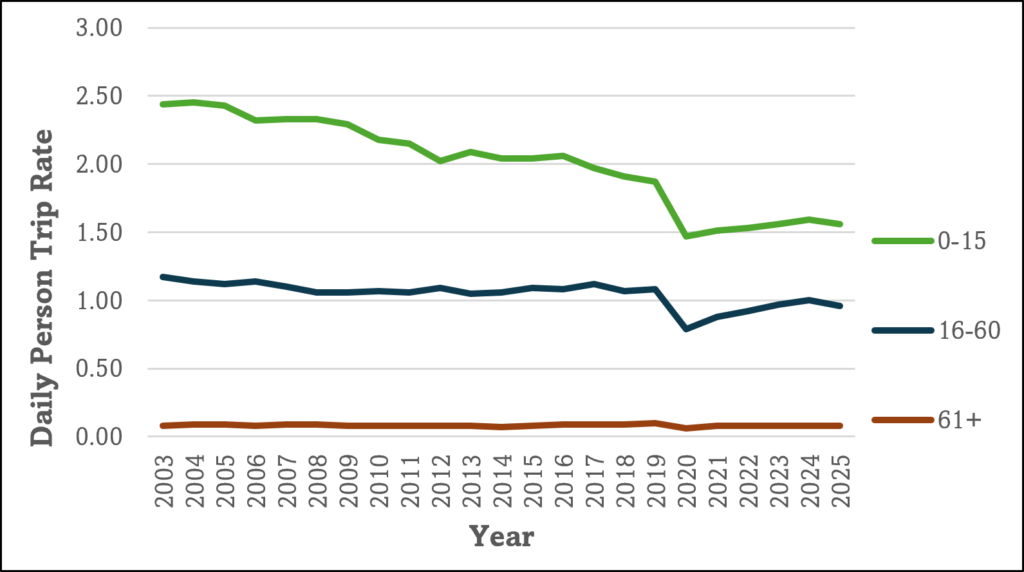
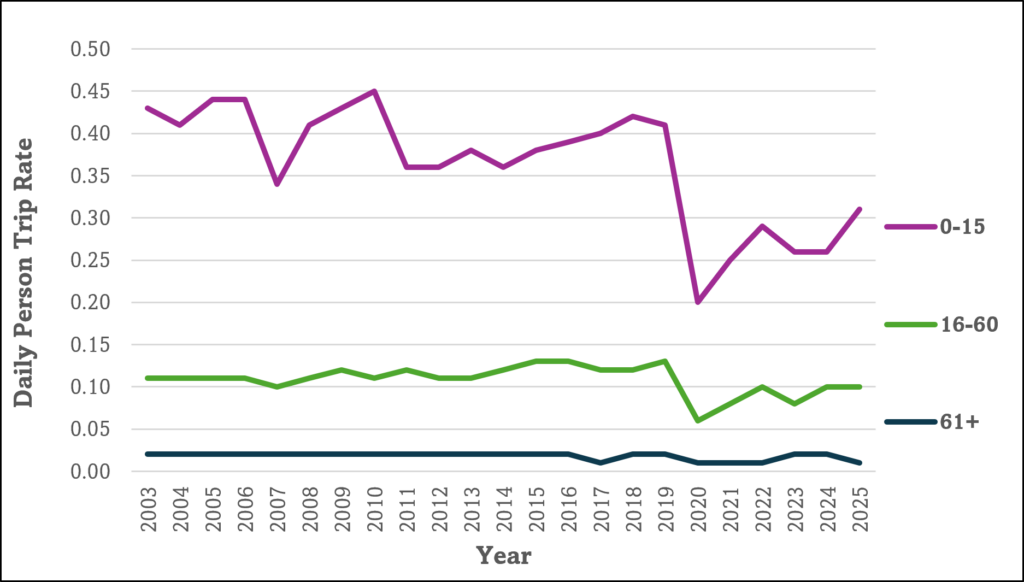
Analysis of the American Time Use Survey data, as shown in Figures 4 and 5, indicates that the decline in trip making is most pronounced for short trips—those of up to 15 minutes for auto and non-auto travel modes. This explains—to some degree—the lack of commensurate decline in vehicle miles traveled. In addition, increases in commercial, service, delivery, and freight traffic have partially offset reductions in vehicle miles traveled attributed to declines in person trip making.
The share of roadway travel attributable to household travel has declined from more than 80 percent in 2001 to 65.6 percent in 2017 and to a low of about 58 percent during the COVID-19–impacted 2022 time frame (18, 19). Variability in data sources, data quality, and evolving trends affect confidence in these numbers. Nonetheless, there is compelling evidence that the share of all travel attributable to households accomplishing household-related activities has diminished significantly.
Implication of Changes in Travel
The pronounced changes in travel behaviors have multiple implications for transportation planning and policy. Some of the more significant implications are noted below.
Travel-Demand Growth Isn’t What It Used to Be
Population growth has slowed and is predicted to continue to be much slower than in the 20th Century. In addition, there has been no growth in per capita vehicle miles traveled since its peak in 2005. Various Census Bureau data analyses indicate that half or more of U.S. counties have lost population over the past few decades (20). A few large cities have had slow or no growth during the current century. Several Northeast and Midwest cities have population levels well below those that existed during their peak years in the 1900s, when much of their existing transportation infrastructure was developed.
The Role of Planners
The planning community has historically focused primarily on meeting demand by providing capacity. While this will still be important in rapidly growing areas, new lane miles of roadway facilities—to enhance connectivity, as well as system capacity—can play a much more modest role in transportation planning and investment going forward, absent of dramatic changes in the aforementioned trends. Some communities—particularly those with a declining population and potentially more modest economic activity levels—are seeing lower travel demand for roads and transit and may struggle to support their existing roadway and transit infrastructure and services. Planners’ attention should focus more on safety improvements, technology integration, the impact of mitigation, maintenance, and enhanced resilience of existing infrastructure.
Causes and Consequences of Lower Trip-Making Levels
Lower trip making affects everything from ridership forecasting and measuring the traffic impacts of new developments to the relevance of historical estimates of induced demand. While technological change and the growing ability to conduct activities virtually play a major role in shaping the evolution of activity-related travel behavior, demographic shifts may also be contributing to the observed decline in household trip making. The United States is experiencing steady population aging, historically low marriage and birth rates, and a growing share of single-person and zero-worker households. These changes influence daily activity patterns, trip purposes, and overall travel needs.
Older adults generally travel less frequently than working-age populations; smaller households generate fewer joint and maintenance trips; and households without children often have fewer school, escort, and activity-related travel obligations. At the same time, delayed household formation and changing lifestyles among younger generations are reshaping patterns of work, residence, and social engagement. Taken together, these demographic dynamics suggest that at least part of the decline in household trip making may be closely linked to evolving population characteristics. Recognizing the interplay between demographic change and technological transformation is critically important for developing a more complete understanding of how and why travel behavior is evolving.
The diminished level of trip making and the nature of that decline by trip duration and mode merit reflection by planners. As policy makers are challenged with understanding phenomena such as the softness in transit ridership over the last decade (particularly since the onset of COVID-19), it is important to recognize that part of the decline is a matter of fewer trips being made overall for work commutes and other purposes. Shorter local trips, which primarily involve walking, biking, and public transit, have been most affected by the decline in personal travel.
Think of this trip rate decline in development terms: It is equivalent to suggesting that a neighborhood would need to be about 30 percent denser to generate the same number of potential transit, bike, or walk trips as has historically been the case. It is not surprising, then, that transit struggles to be as productive as it was in the past, and advocacy of biking and walking has had only a modest impact on use levels.
Rethinking Travel Behavior Theory
The transportation planning mindset has largely revolved around a four-step process that focuses on the following:
- Generating a household trip,
- Choosing a destination,
- Deciding on a travel mode, and
- Selecting a travel route.
The interrelatedness of those decisions is acknowledged, and activity-based models recognize the interdependence in household travel choices. But what is often missing is an understanding and explicit representation of how communication has emerged as a competitor to travel. Traditional travel-demand forecasting can address changes in trip rates associated with changes in demographic characteristics, as well as geographic distribution of destination opportunities. However, there are few robust capabilities to forecast changes in trip making that may be associated with ongoing modifications in communication capabilities and propensities, as well as continuing changes in the opportunities and willingness to procure services to—in effect—outsource household travel.
In this context, traditional processes of thinking about travel with regard to generating a trip, choosing a destination, deciding on a travel mode, and selecting a travel route might better be characterized as a process where the first step is a decision about whether to generate a household vehicle trip or outsource the activity. The latter choice would turn a personal trip into a trip tour—or part of one—by a service provider or delivery business.
An example of how that conceptual relationship might change would be the decision between going out to eat, picking up a takeout meal, or using a meal delivery service. If the choice is to carry out an activity, the next step might involve a decision about whether to accomplish the activity through communication or through travel, such as going to a bank to deposit a check or doing it through a phone app. If travel is chosen, then the subsequent decision steps would follow the traditional choices represented in a classic four-step travel-demand model. A variant would be to think of the decision to travel or engage virtually as an element of the mode choice decision, with telecommunications serving as one of the modal options. However, such a specification would have significant implications on how the model is structured and interdependencies across activity travel choices are captured.
As observed changes in trip-making levels are increasingly disconnected from demographic changes, the need for building a more robust and modern behavioral foundation for forecasting trip making is borne out by the meaningful decline in household trip making and the growth in service and delivery travel trip volumes over the past few decades. Without a sound theoretical and methodological framework for forecasting trip-making rates that accounts for the growing propensity to conduct activities virtually, it will be difficult to determine the overall level of travel and the extent to which trips are undertaken by household members versus service providers. This presents a significant challenge for accurately predicting future travel patterns critical to long-range planning.
Non-Work– and Non-Household–Based Travel
Many of the traditional planning processes focus primarily on household travel, with an emphasis on work travel to ensure that peak-period travel conditions are captured effectively. Other travel segments, such as freight, long distance, commercial, and service-vehicle travel, get less attention and are often treated as add-ons or factors on top of household travel. Recent data suggest that these segments are very significant and represent a growing share of total travel. This has multiple implications. For example, compared with household travel vehicles, freight and commercial vehicles are typically larger, consume more energy, emit more emissions and noise, have a greater impact on infrastructure, and can have greater crash outcome risks associated with their larger weight and longer braking distances.
Even lighter vehicles used for service and commercial functions often carry out trip tours or ferry materials and supplies. Thus, they are not as likely to be able to use alternative modes as might be typical of routine household-member trips. Commercial- and service-vehicle travel decisions may have different sensitivity to factors such as managed lanes, fuel pricing, congestion levels, parking cost, or other factors when compared with household-based travel. Accounting for the behaviors of this ever larger segment of total travel is critical to accurately predicting future travel demand and identifying non-household travel choices that may be influenced by planning policies and investment decisions. Supply chain resiliency concerns resulting in meaningful increases in domestic manufacturing or utilization of multiple sites for domestically sourced materials may further increase domestic travel demand.
Further understanding of travel associated with freight, business, commercial, and service vehicle use will require additional data collection and a stronger understanding of travel demand and behaviors for these trip types.
Adapting to Greater Uncertainty
The current era reflects far greater uncertainty and dynamic changes in conditions that impact transportation than existed in prior decades. Among the uncertainties are the following:
- Growing virtual activity participation and product and service delivery;
- Shifting migration and residential location patterns;
- Changing supply chains and scale of onshore manufacturing operations;
- Expanding delivery services and mobility-as-a-service options;
- Accelerating pace and nature of autonomous vehicle deployment (service model or personal ownership);
- Advancing pace and extent of adoption of micromobility and advanced air mobility travel options, such as flying taxis; and
- Unknowns related to changes in attitudes, technology, the economy, or policies that might affect future transportation.
The collective consequences of these changes call for a significant update of planning processes and methods. Planning and data collection would benefit from being more dynamic to keep up with changes in technologies and conditions, more adaptive to the large variation in contexts across geography, and more sensitive to the evolving values and behaviors of travelers and the public. These conditions call for greater emphasis on adaptability and flexibility in planning, explicit recognition of uncertainty, careful consideration of the spatial and temporal distribution of costs and benefits, and a reassessment of the time horizons used for planning initiatives.
As the pace of change accelerates, planning must remain true to its fundamental purpose of informing sound decision making while simultaneously evolving and innovating to meet the demands of a rapidly changing world.