

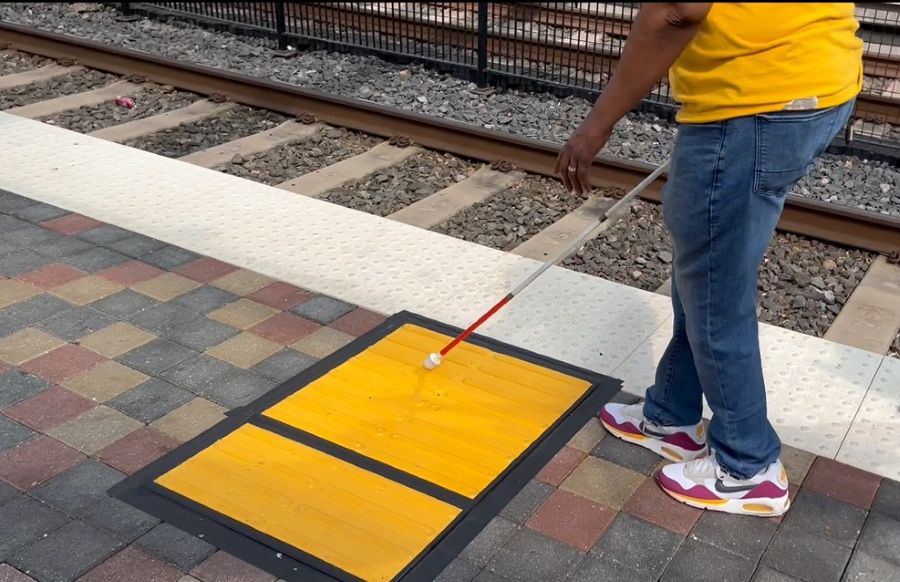
 Source: Sarah O'Brien from TCRP Research Report 248, Vol. 1
This article is partially derived and excerpted from TCRP Research Report 248: Tactile Wayfinding in Transportation Settings for Travelers Who Are Blind or Visually Impaired: Volume 1: Conduct of Research
Travelers who are blind or visually impaired use a variety of cues and strategies to orient themselves within their surroundings and move through space to where they want to go. This wayfinding process can be particularly challenging in complex urban environments where some cues, such as detectable pavement edge treatments, the sound of accelerating traffic, or other indicators may be inconsistent, confusing, or missing. Tactile walking surface indicators (TWSIs) can be any walking surface that is intentionally used to provide warning or guidance information through touch to people with vision disabilities. While digital wayfinding technologies have developed more recently to overcome the challenges in traveling through the built environment, not all people who are blind or visually impaired have access to or are able to use these technologies. Thus, as discussed in TCRP [Transit Cooperative Research Program] Research Report 248: Tactile Wayfinding in Transportation Settings for Travelers Who Are Blind or Visually Impaired: Volume 1: Conduct of Research, TWSIs are important to provide physical and tangible information.
In the United States, the only standard TWSI is the detectable warning surface of raised truncated domes. This kind of surface indicates the boundary between a pedestrian path of travel and a vehicular route to serve as a warning to pedestrians to check for hazards before proceeding. They are located at the bottom of curb ramps, along at-grade rail crossings, on transit boarding platform edges, and at street-level rail boarding areas. Research and practice suggest that other TWSIs may aid in wayfinding tasks by doing the following:
- Guiding travelers along a route
- Marking the locations of street or rail crossings, as well as where transit doors open
- Providing cues for establishing a directional heading
- Delineating a boundary between a pedestrian path and a vehicular path where both are at the same elevation.
Internationally, research and practice suggest that other TWSIs may aid in wayfinding tasks. Two such surfaces are the tactile direction indicator (TDI) and the trapezoidal tactile warning delineator (TWD). The TDI is a surface comprised of raised, parallel, flat-topped, elongated bars, whereas the TWD is a single, long, raised element that is trapezoidal in shape when viewed in profile.
There are no standards for either wayfinding infrastructure in the United States, nor is there research on how different TWSIs may function effectively together as a wayfinding system. One insight resulting from the report is that extending the alert–locator bars of TDIs in transit stations to the full width of the walkway allows travelers to not miss them on approach. One area of suggested research includes determining if certain types of turns can be easier to navigate when a person is following a TDI.
Once a tactile wayfinding system has been constructed, the report emphasizes that post-implementation activities should ideally include assessing the project’s effectiveness to gain knowledge to apply to future projects and maintaining the tactile surfaces so that the system retains its effectiveness over time.
In addition, it is important to consider the impact that TWSIs may have on people with mobility impairments, as the geometries that may make a surface more detectable and identifiable to people who are blind may have the same characteristics that cause problems for people with mobility impairments. For example, the orientation and placement of TDIs may cause more vibration for people using wheeled mobility aids when the bars are oriented perpendicular to the direction of travel.