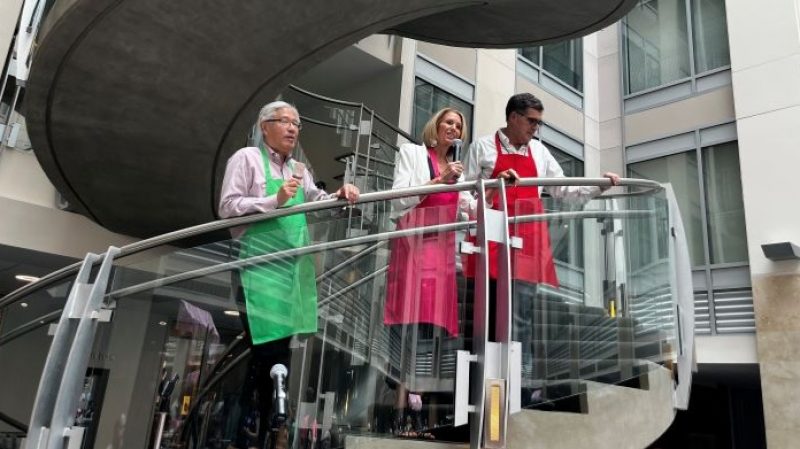

In this Utah Department of Transportation (DOT)–produced video, Blaine Leonard, Transportation Technology Engineer for Utah DOT, describes how the Connecting the West Program will serve as a digital seat belt to keep road users safe across three states. (Courtesy of Utah DOT)
This article is partially derived and excerpted from the Utah Department of Transportation’s Connecting the West Program website.
In Utah, an unacceptable number of crashes occur at intersections, in work zones, along rural corridors, and during bad weather. Increasingly, incidents at intersections involve pedestrians, cyclists, and other road users. Such occurrences—along with road construction, and inclement weather—can also result in frequent slow-downs on interstate and rural corridors that impact the traveling public. Additionally, buses can experience delays that affect route performance, rider mobility, and transit agency operations costs. With several major corridors that have significant commercial freight traffic, truck drivers often lack information about road closures and weather conditions, which causes uncertainty in their travel planning and alters their delivery deadlines. Such problems are not unique to Utah.
In June 2024, the Utah Department of Transportation (DOT) received a $20 million grant from the U.S. Department of Transportation (U.S. DOT) to establish the Connecting the West Program. This funding enables Utah, Colorado, and Wyoming DOTs, as well as other partners, to implement innovative technologies that can save lives and increase mobility, advancing the U.S. DOT’s mission of deploying connected vehicle networks on a national scale. In addition to the federal funds, Utah DOT and its partners have secured $6.54 million, bringing the total project value to more than $26 million.
Through multiple real-world applications of vehicle-to-everything technologies, which allow a vehicle to share sensor, camera, and internal system data with other vehicles, Utah DOT is creating a digital seat belt that advances its goal of zero fatalities on the state’s roads. For example, lidar technology will improve safety at intersections by alerting drivers to pedestrians and cyclists crossing the street. Signal preemption will allow snowplows to clear roads faster and gives priority to buses so that riders can get to their destinations on time.
As part of this collaboration, key infrastructure components and transportation-related technologies will continue to be deployed across the three states. These include traveler information messages with warnings about icy roads and lane closures that can be sent to drivers across state lines.