
 Ian Patterson
Fast-moving traffic. Distracted or impaired drivers. Poor visibility. Such factors can make crossing the street tricky, particularly in cities, where the majority of pedestrian injuries and fatalities occur. The growing presence of robot taxis and other autonomous vehicles in metropolitan areas from Atlanta, Georgia, to San Francisco, California, could compound the challenges.
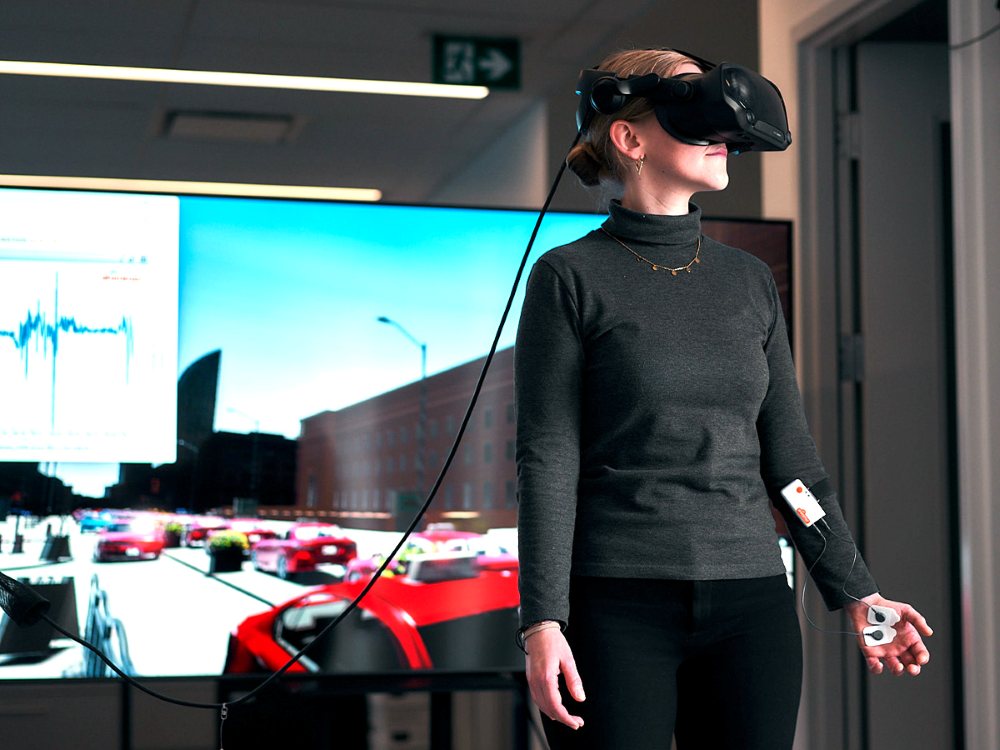
Researchers at Toronto Metropolitan University in Toronto, Ontario, Canada, are pioneering a novel approach to improving pedestrian safety: using virtual reality to illuminate behavior. In a first-of-its-kind study, a team from the university’s Laboratory of Innovations in Transportation (LiTrans) outfitted 171 participants with virtual reality goggles and sweat-detecting sensors to track their stress responses as they navigated across an immersive, computer-generated street that simulated driving and cycling interactions. Since stress is known to affect decision making, capturing emotional reactions to test environments in real time could yield clues for reducing midblock crossings and other risky pedestrian behavior, as well as designing safer streets.
“Having a safe environment where we can test different variables and look at their effect ensures that people’s behavior would be realistic,” explains LiTrans director Bilal Farooq. The safe experimental space of his lab’s Virtual Immersive Reality Environment platform has enabled investigations into a range of other real-world transportation safety challenges, including distracted pedestrians and interactions between pedestrians and automated vehicles.
The 2025 pedestrian-stress study revealed several key safety-related findings. For example, “the presence of a street median served as a refuge for the pedestrians, significantly reducing stress levels by providing a safe midpoint during the crossing,” recounts Farooq. Including such infrastructure in street designs could help save lives in midblock areas—a primary location for pedestrian fatalities in Canada. The study—part of a decade-long initiative to use virtual reality for urban research—also found significant age-related differences in participants’ stress levels. Those who were 18–24 years old appeared calmer than participants between the ages of 55 and 65.
Beyond encouraging safer street designs, such virtual reality–enabled research has relevance for the autonomous vehicle industry and urban planning. Currently, pedestrians and drivers typically make eye contact, exchange nods, or otherwise silently signal each other’s presence before proceeding. By collecting behavioral data from pedestrians, immersive virtual reality experiments help inform deep-learning models that can predict street-crossing behavior and train self-driving vehicles to react. The findings also may prove useful to cities seeking to adjust policies, regulations, and rules in preparation for future mobility technologies.
Learn more about the Laboratory of Innovations in Transportation’s use of virtual reality to improve pedestrian safety here, and see a demonstration of the project’s technology in this research talk by the study’s lead author.