
Hannah Twaddell has an ear for harmony. A classically trained pianist and singer, she delights in creating “a wide range of joyful noise” with congregants as her church’s music director. She derives similar satisfaction from uniting disparate viewpoints through her work. For the past 38 years, the Charlottesville, Virginia–based transportation planner has helped forge consensus on a broad array of regional, state, and nationwide multimodal transportation initiatives. Her secret? Listening to—and involving—residents in shaping their hometown’s future.
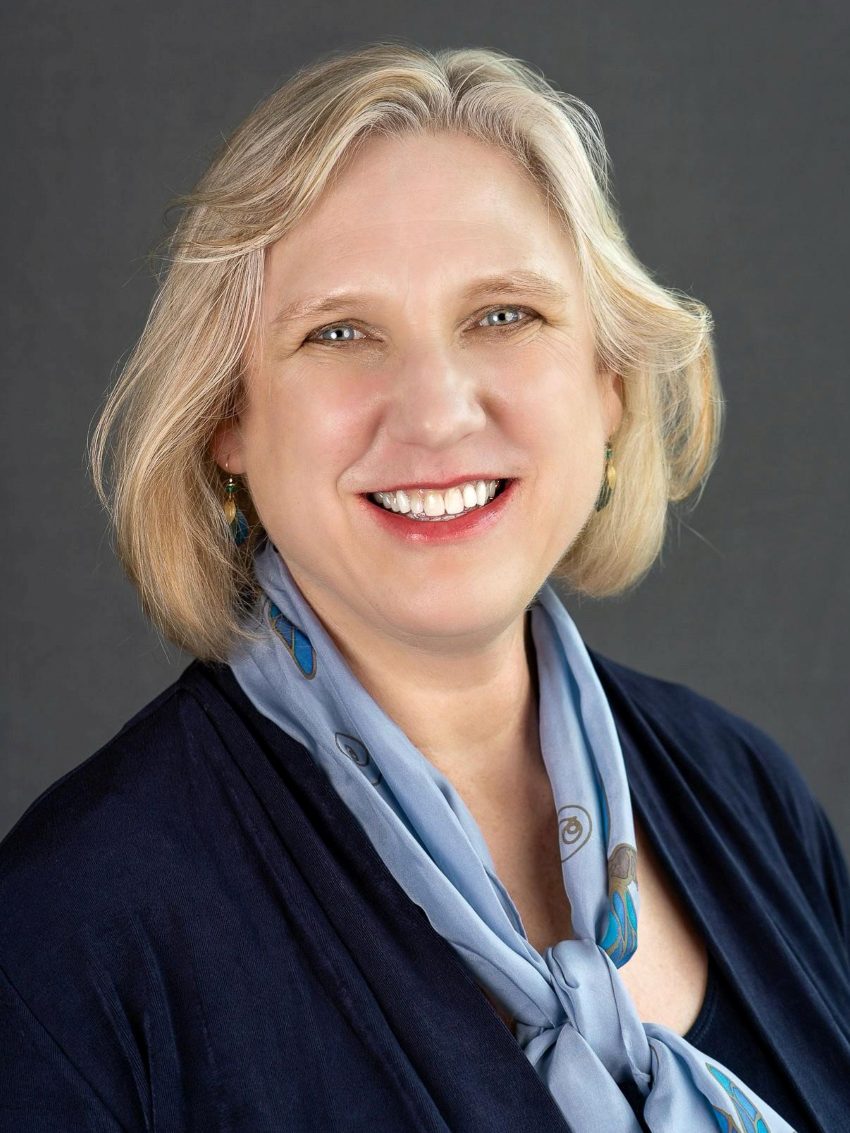 Courtesy of Hannah Twaddell
Twaddell, a senior principal transportation planner at ICF, never envisioned becoming a nationally recognized expert in scenario planning or a specialist in integrating transportation plans with community development and urban design policies. Music had been her passion since childhood, and the concert hall seemed her likely destination. Nor could she have foreseen—while earning her bachelor’s degree in English and music history and theory at Oberlin College and Conservatory in Oberlin, Ohio, in the early 1980s—the pivotal influence a required nonhumanities course would have on her career path.
Assuming that she would need to understand computers in the future, Twaddell opted to take a software programming class. “I scraped by with a [grade of] C but learned the most important lesson about models,” she recalls, “They do what you tell them to do, which is not necessarily what you want them to do.” Twaddell turned that insight into a transferrable skill at the University of Pittsburgh in Pennsylvania, where she received a master’s in teaching in 1986. Whether working with people or models, she realized, “if the results aren’t what you want, you have to make your instructions clearer.”
Transportation planning offered an unexpected opportunity to blend a musician’s training in theoretical analysis with educational techniques gleaned in graduate school. Recently married and living in the Charlottesville farmhouse her husband’s grandfather had built, Twaddell joined the Thomas Jefferson Planning District Commission—the technical and research support staff for the Charlottesville–Albemarle Metropolitan Planning Organization (MPO)—as a senior planner. The largely rural region, home to the University of Virginia, was struggling with traffic generated by rapid growth and sprawl, so easing congestion was her early focus. To beef up her skill set, Twaddell took a three-week class on travel-demand modeling. It became a life-changing exercise in critical thinking that transformed her approach.
“I knew nothing about the subject and leveraged my ignorance as a reason to ask lots of annoying questions,” recalls Twaddell. She quickly realized that the travel-demand model essentially was designed to address just one question: Where should we expand highways to reduce predicted congestion? Since her region wanted to explore other strategies for reducing congestion, such as incentivizing people to walk, bike, and take transit, Twaddell dug into the kinds of data the model used—or omitted—and challenged the assumption that every trip was by car. She suggested alternatives, such as distributing person–trips across all travel modes and testing different land-use patterns that could make trips shorter and more walkable, but she hit roadblocks. “I had thought I needed a new model, but I discovered that we really needed a whole new approach to transportation planning,” explains Twaddell.
After seeking funding through the regular MPO process for “several frustrating years,” Twaddell wrote a successful FHWA grant proposal to create a new modeling tool that would let her explore more comprehensive scenarios and generate alternative trip data. Most of the region’s land-use information and nonhighway network data were available only on paper maps and records. Moreover, the agency’s computers couldn’t run complex software. Therefore, the analysis tool had to be simple to construct and run yet sophisticated enough to produce meaningful, defensible results.
“I had thought I needed a new model, but I discovered that we really needed a whole new approach to transportation planning.”
—Hannah Twaddell
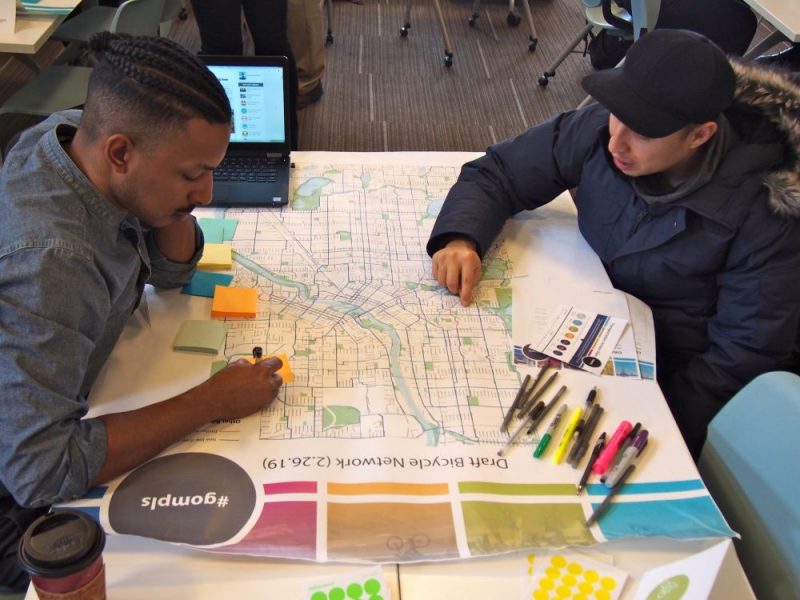
The result was an innovative spreadsheet model that incorporated cutting-edge research on the relationship between the built environment and travel behaviors. It let planners build and evaluate scenarios created by the community through a series of drawing exercises and mapping games. Leading a team of local planners, University of Virginia faculty, and consultants who staffed a 36-member citizen advisory committee, Twaddell developed and deployed the new scenario planning method and toolset to create a 50-year vision for the region. Completed in 2002, the Jefferson Area Eastern Planning Initiative laid out a strategy for a coordinated array of walkable communities connected by a multimodal street network.
Excited to share the new planning tools and processes with other MPOs and communities, Twaddell, then the Thomas Jefferson Planning District Commission’s acting executive director, decided to switch to consulting. Until joining ICF in 2014, she led various integrated land-use and transportation planning initiatives throughout the United States. Her scenario-planning studies and community design workshops ranged from fast-growing suburbs grappling with traffic to industrial regions eager for revitalization. She was co-principal investigator of a National Cooperative Highway Research Program research report on integrating land use and transportation in rural communities. She also contributed to FHWA’s pathbreaking Livability in Transportation Guidebook, and collaborated with AARP on research and planning to support safe mobility in communities with aging baby boomer populations.
Her ICF projects span an equally wide array of topics, from bicycle and pedestrian connectivity to public involvement. She also has developed national guidebooks, detailed case studies, and peer exchanges and trainings on scenario planning, including applications of FHWA’s VisionEval strategic modeling toolset. “All of that knowledge and experience,” she reflects, “was sparked by that moment when I decided to look under the hood of the traffic model and ask why it couldn’t do what I wanted.”
TRB has helped fuel Twaddell’s knowledge base since the early 2000s, when she was appointed to the predecessor of what is now the Standing Committee on Transportation Planning, Analysis, and Applications. “I couldn’t get over the idea that simply offering my thoughts was a valuable service,” marvels Twaddell, who was accustomed to raising funds and organizing events as a volunteer for community groups and professional associations. She also was used to encouraging broad participation. As chair of the predecessor committee from 2018 to 2025, she dedicated time at every meeting for presentations and discussions with study leaders, partner agencies, and peer organizations. She also instituted open mic updates for committee members and friends to share their work and research ideas. A favorite outcome from these informal discussions was the productive relationship that developed with the AASHTO Planning Committee’s research subcommittee and other practitioner organizations.
To engage broad constituencies, Twaddell draws on her graduate training in teaching to distill complex concepts into understandable language. Her portfolio of publications includes a Planning Commissioners Journal column that—from 2004 to 2012—provided succinct guidance for planners on topics from bypasses to international food shipping to parking regulations. Twaddell also leverages a fearless curiosity forged by joining the college swimming team her senior year. She had never participated in any organized sport and spent every practice trying not to drown. “I managed to win only one race,” she relates. “But I gained the invaluable skill of risking humiliating failure to figure out something I don’t know how to do—and still use it every day.”
Twaddell foresees a surge of unprecedented opportunities for the next generation of planners and analysts to address entrenched challenges as artificial intelligence–enabled tools emerge. She has a rare backyard window on the long-term impact of their work. Few Charlottesville residents may recall Twaddell’s first scenario planning initiative. But 25 years later, many of its land-use policies and transportation investments have been realized—such as grids of suburban connector streets that support walkable, mixed-use redevelopment and alleviate congestion. “In my own community and countless others, I’ve witnessed how a strong vision becomes woven into a community’s collective unconscious, quietly and persistently influencing daily decisions,” she observes. “For better or worse.”