

 Micah Maziar, Flickr, CC BY-NC-SA 4.0
What do the terms “Show Low,” “Falls of Rough,” and “Eek” have in common? All are names of small U.S. airports—in Arizona’s White Mountains, near Kentucky’s Rough River State Park, and on Western Alaska’s Eek River, respectively—and they are part of a vital transportation network for most Americans.
FAA categorizes approximately 4,000 airports around the country as small (1, 2), and 90 percent of the U.S. population lives within a 30-minute drive of one of them (3). This article focuses on the many capabilities of small airports, particularly during diverted flight events, and draws from research in Airport Cooperative Research Program (ACRP) Synthesis 121: Managing a Flight Diversion with an Emergency Response at Small, Non-Hub, or General Aviation Airports. It also provides updated perspectives from airports that participated in ACRP Synthesis 121 research, including through surveys and interviews on practices and procedures, as well as from small airports that managed recent diversion events.
Defining Moment
One of the most famous airports in North America defined as small by annual volume of commercial air traffic—though not by capacity or capabilities—is Gander International Airport in Newfoundland and Labrador, Canada. Located in the town of the same name with a population of 10,000, it gained renown for hosting nearly 7,000 passengers and crew members from 38 wide-bodied jets that diverted when U.S. airspace closed in response to the September 11, 2001, terrorist attacks (4). The community’s herculean feat 25 years ago was recounted in the musical Come From Away. The show depicts the power and resourcefulness of residents who came together to meet the needs of stranded travelers until they could resume their journey several days later.
 Courtesy of the Gander Airport Historical Society
Gander handled this volume because the airport is situated on a remote, expansive location and features an extensive airfield with exceptionally long runways that can receive the largest aircraft in the world—a product of its beginnings as a refueling stop for transatlantic flights. Still, the challenge was enormous. To maximize scarce space, crews parked the commercial aircraft nose-to-tail on runways, taxiways, and tarmacs. Airport authorities also focused on how to screen, deplane, and clear everyone through immigration and customs—a process that took 24 hours. The passengers then needed lodging and food. Local emergency response volunteers and community leaders arranged school buses for transportation and an ice rink to store perishable food. The regional telephone company installed banks of free public telephones, and residents opened schools, churches, meeting halls, and even their homes to shelter the “plane people.” Gander presents a common story of what small airports do regularly: demonstrate their resiliency through quick problem solving and ingenuity during unexpected events.
Types of Small Airports
Small airports collectively form an airspace safety net, receiving diverted flights when aircraft cannot reach their intended destinations. However, there are a variety of small airport types, and each serves a different yet vital purpose in the air transportation system.
Small-Hub Airports
Sometimes called regional airports, these are the largest of the small airports. As Table 1 highlights, FAA currently categorizes 77 airports as small hubs, including those in Wichita, Kansas, and Spokane, Washington. In 2024, small-hub airports enplaned (i.e., boarded) 93 million passengers of the nation’s 983 million total enplanements (1). Most of these small hubs service regional airlines, business jets, and small aircraft, along with some cargo aircraft. They primarily act as a spoke in the hub-and-spoke system, connecting passengers to their destination city through medium- or large-hub airports. However, some also serve airlines that offer direct flights to leisure destinations.
TABLE 1 Definitions of Annual Enplanement Ranges for Smaller U.S. Airports (1,2,5)
| STATUTORY DEFINITION | CRITERIA | NUMBER OF U.S. AIRPORTS BY CATEGORY | ENPLANEMENT RANGE WITHIN EACH CATEGORY (FY 2023) |
|---|---|---|---|
| Small Hub | Receives 0.05% to 0.25% of the annual U.S. commercial enplanements. | 77 | From 474,885 (Appleton International Airport, WI) to 2,307,887 (Norfolk International Airport, VA). |
| Non-Hub | Receives <0.05% but more than 10,000 of the annual U.S. commercial enplanements. | 254 | From 10,038 (Hays Regional Airport, KS) to 2,307,887 (Missoula Montana Airport, MT). |
| Nonprimary Commercial Service (Non-Hub) | Also referred to as non-hub nonprimary, these airports have scheduled passenger service and between 2,500 and 10,000 annual enplanements. | 119 | From 2,514 (Marshall Don Hunter Sr. Airport, AK) to 8,750 (Yellowstone Airport, MT). |
| Reliever | An airport designated by the Secretary of Transportation to relieve congestion at a commercial service airport and to provide more general aviation access to the overall community. | 267 | From zero (St. Clair County Airport, AL) to 37,126 (Rocky Mountain Metropolitan Airport, CO). |
| General Aviation | A public-use airport that does not have scheduled service or has scheduled service with <2,500 passenger boardings each year. | 3,281 | Range (% of airports) Zero (48%) 1–100 (45%) 101–10,000 (6%) >10,000 (1%) |
| SOURCE: | Aviation Innovation |
Non-Hub Primary Airports
These airports, located in cities including Amarillo, Texas, and Billings, Montana, offer low-cost carrier flights but provide fewer of them than small hubs. These 254 airports enplaned 29 million passengers in 2024 (1). They primarily function as part of a point-to-point network, connecting directly to destination cities, but they sometimes act as a spoke in the hub-and-spoke system.
Non-Primary Commercial Service Airports
Serving small cities such as Altoona, Pennsylvania, and Crescent City, California, these airports are similar to non-hub airports but enplane fewer passengers—between 2,000 and 10,000 people annually (5). They provide occasional commercial airline service to rural communities but mainly focus on cargo, corporate, and charter flights, as well as flight training services for commercial and military pilots.
General Aviation Airports
These facilities specialize in flights for civilian, business, charter, medical (e.g., medevac and organ transport), and agricultural (e.g., crop dusting) use. They also house flight-training schools and law enforcement and firefighting services.
Reliever Airports
A specific type of general aviation airport located near major cities, these 267 airports base aircraft away from congested large hubs to improve their efficiency (2). Typically, several reliever airports are positioned around one large hub to help manage air traffic.
Workforce and Economic Benefits
Small airports make a significant contribution to the U.S. economy. According to a 2023 study, general aviation airports alone contribute $339 billion of economic activity annually within the United States. This figure derives directly from airport flight operations and indirectly from transporting goods to and from local industries in an area. Non-hub airports have focused on air cargo operations since the mid-1980s, when deregulation sparked a wave of airline mergers and shifted passenger traffic to larger airports that served these newly dominant carriers. General aviation airports support their local hospitality industries by bringing in visitors who spend approximately $4.4 billion on lodging and $2.2 billion on food and beverage annually.
These airports are often significant community employers, especially in rural areas, and sometimes even drive economic activity in a region. The 2023 study indicated that small general aviation airports support 1.3 million jobs nationally and indirectly support aviation-related industries such as cargo and maintenance, as well as medical, agricultural, and other non-aviation fields (6).
Service and Societal Roles
Small airports expand the reach and capacity of the national air transportation system by providing crucial services to remote communities that are impractical for medium and large hubs. They connect small towns and rural residents to the largest airports with multiple flights to national and global destinations. Small airports—mainly non-hub and general aviation airports—also are frequently used as essential service bases for air ambulance transport, search and rescue operations, and disaster relief efforts. For example, Page Field, a general aviation airport in Fort Myers, Florida, acts as a first-responder base for rescue efforts during hurricanes by transporting people who need medical care or carrying supplies to residents stranded on nearby barrier islands.
 Ian DeGraff, Dane County Regional Airport, Flickr, CC BY-ND 2.0
Additionally, general aviation airports offer travelers a convenient alternative to medium and large hubs. They serve business and private aircraft, enabling passengers to access metropolitan areas with fewer delays and ground congestion than they would encounter at major airports. Reliever airports, which offer simpler access and shorter security lines, can also provide less stressful and more streamlined travel experiences for local and regional passengers.
 Steve Dahlgren, Dog Grin Photography/Dane County Regional Airport, Flickr, CC BY-ND 4.0
A significant role that small airports play daily is relieving congestion and reducing air traffic delays at larger airports. ACRP Synthesis 121 found that small airports typically manage 40 percent of all diverted flights in the United States each year. These diverted flights can range from routine instances—for example, when thunderstorms erupt near a large hub and prevent planes from landing—to anything else, such as medical emergencies that arrive at night during a major weather event. Regular gas-and-go flights need a place to land, quickly fuel up, and get back in the air. For these, small airports coordinate with a fueling company and communicate with air traffic control. More complex incidents might require ground crew assistance to resolve an aircraft mechanical issue. Emergency diversions can entail an urgent medical issue that requires coordination with local medical services. Thousands of these types of scenarios occur daily at small airports.
How the Small Become Mighty
 Cory W. Watts, Flickr, CC BY-SA 2.0
Although reliever airports play a considerable role in managing diversions since they are strategically located near larger airports, all airports—no matter what their size—are legally required to accept diversions. These situations infuse revenue from landing fees into small airports while benefiting the entire air system by alleviating congestion at larger hubs. However, such events often affect small airports more significantly than medium- or large-hub airports.
Most small airports have capacity constraints, such as fewer gates and shorter runways, compared with larger airports. Some also have aging, outdated facilities and limited staffing, which can prevent them from singlehandedly managing all types of diverted flights. Often, a small airport serves only a couple of airlines. That makes handling diversions from airlines with no on-site base of operations a challenge, since these airports have no designated equipment, maintenance crews, or gates on hand. In such cases, small airports focus on five factors that support success before, during, and after diversion events (Figure 1).
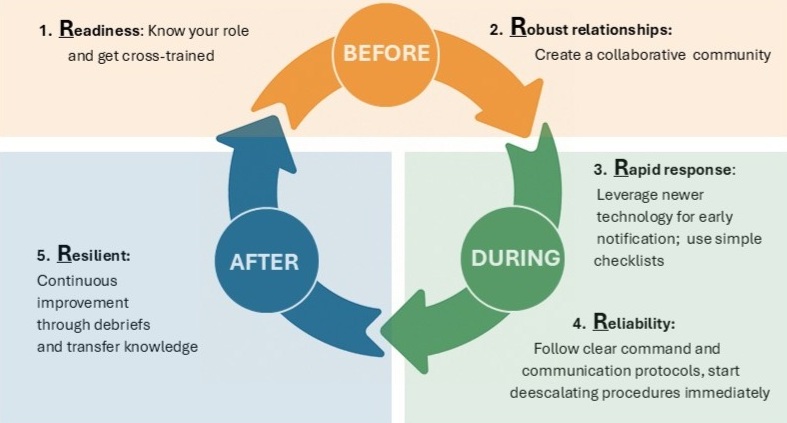
ACRP Synthesis 121 outlines how many small airports remain ready every day to accept diversions. Readiness involves ensuring that staff understand diversion-related roles and responsibilities before an event occurs. This begins formally through written plans or informally through word of mouth but always involves some sort of training. Small hubs and relievers typically include staff duties for diverted flights in written plans such as the following:
- Airport emergency plans,
- Irregular operations plans,
- Continuity of operations plans,
- Standard operating plans, and
- Diversion checklists.
Airport leaders from non-hub and non-primary commercial service airports may not always use written plans. However, they know what needs to be done and provide on-the-job training in diversion response.
Understanding what steps to take, where to look for additional instruction, or whom to ask for help are the main focal points of training efforts. “We have a lot of plans and procedures for diversion events, but training is critical as we can’t just let plans just sit on a shelf,” explains Blaine Peterson, Manager of the six reliever airports associated with Minneapolis–St. Paul International Airport in Minnesota. Teaching staff members such basics as why they need to be prepared for the unexpected, how to keep runways available, and when to update airfield condition reports is “of top importance,” he adds.
Expect the Unexpected
One effective training practice for small airports involves cross-training staff so that they are more versatile, agile, and able to take on multiple roles to handle events that can happen around the clock. For example, the airport police at Lincoln Airport in Lincoln, Nebraska, are trained in many areas of airfield operations. “This allows them to respond and assist in a variety of diversion and other irregular situations,” notes Michael Griffin, Director of Operations and Maintenance.
Still, it can be challenging to ensure that every airport worker—including employees of businesses that refuel or repair aircraft, provide passenger goods and services, and other stakeholder organizations—knows what their diversion-related responsibilities entail. That is especially true if one or more of those organizations regularly experience high turnover or attrition rates.
Some smaller airports establish effective communication frameworks by creating a list of current primary and backup contacts to receive diversion notifications. Airports that do this best have created a process and leverage technology to maintain and update contacts on a regular basis. Still, encountering the unexpected sometimes reveals where improvements can be made.
 Courtesy of Hector International Airport
Darren Anderson, Assistant Director of Hector International Airport in Fargo, North Dakota, recalls the challenges of managing an international flight that diverted with a medical emergency. Those challenges ranged from locating equipment to difficulty finding a proxy on site to serve as the airline’s deputy station manager and make immediate decisions. “We had to reach out to various airlines to find air stairs and tow bars that would accommodate this aircraft,” he relates, adding that another airline’s station manager was on site at the time and handled the aircraft.
Joint Effort
Small airports, like medium and large hubs, share working space with a variety of stakeholders. These include airlines, fixed-based operators, fuelers, and other aircraft-related businesses; federal agencies such as the Transportation Security Administration and U.S. Customs and Border Protection; and providers of bus, shuttle, rideshare, and taxi services. For diversion events, small airports may also coordinate with off-airport entities such as FAA, local fire and police departments, hospitals, and even restaurants and retail stores to obtain assistance or resources. With so many stakeholders, successful small airports foster robust relationships by forming formal or informal collaborative networks, ensuring that every link in the stakeholder chain is connected.
“The importance of pre-planning for diversions with relevant stakeholders like air carriers and ground transportation providers is key,” says Raymond Laroche, Chief Operating Officer of Punta Gorda Airport on Florida’s Southwest coast, which coordinates all emergency plan functions, including diversions, with local response agencies and county emergency management. “These agencies have access to a vast number of resources greater than what the airport has access to.”
Resource Sharing
Some small airports informally share plans and updates with relevant stakeholders so all remain current on procedures. Others create a formal letter of agreement or memorandum of understanding with local network partners for the pre-approved sharing of resources. These agreements can cover equipment, supplies, and even staffing to manage predictable diversions caused by weather-related events, as well as incident- or emergency-level diversions caused by widespread system outages or severe health-related issues.
“Agreements and coordination with ground services and fuel providers help turn medical diversions around quickly,” says Wayne Morris, Director of Operations at St. John’s International Airport in the city of St. John’s in Newfoundland and Labrador, Canada. This helps travelers continue to their destination rather than having to disembark. “Agreements and relationships with hotels, buses, and taxis are invaluable when the aircraft must deplane and stay overnight or longer,” Morris continues.
Some small airports are members of regional networks that can share resources and support during diversions and plan for future ones together. For instance, Punta Gorda Airport is part of the Florida Airports Council, a professional association and advocacy group, and meets regularly with members to collaborate on aviation industry-related issues.
Timely Alerts
Because small airports must respond rapidly to fast-moving, unexpected events, early notification of flight diversions is critical. Newer web-based technologies have come out in the past couple of years, including AI and machine-learning software that can alert staff to diversions earlier and predict not only how many people and bags will arrive but also exactly when and at which airports.
Punta Gorda Airport recently implemented two cloud-based platforms—“one to provide us with real-time tracking data, which gives us an earlier warning that diversions are coming, and one to manage aircraft coordination at low altitudes to help with emergency response situations,” reports Laroche, the chief operating officer. Flying Cloud Airport in Eden Prairie, Minnesota, relies on several web-based sources for aircraft arrival information, and multiple TV monitors were added to the breakroom so that staff can keep up with National Weather Service forecast updates. Flying Cloud also uses predictive AI and geographic information system-centric asset management systems that provide real-time equipment status and parts inventory, as well as alerts mechanics when critical components need maintenance.
Checklists and Resource Sharing
Rapid response also involves using guidance that is easy to find and follow, such as the grab-and-go checklist for diversions that Madison, Wisconsin’s, Dane County Regional Airport and other airports have developed. These types of checklists are typically stand-alone task lists that give specific, clear, and precise instructions. They are grouped by role or job, ordered sequentially by task, and include potential responses if escalating factors occur—for example, adverse weather, diversions that occur after normal business hours, or multiple diverted aircraft arriving at once.
Reliable outcomes begin with following a clear chain of command during diversions. Small airports learn standardized practices during regular emergency training—typically those from the National Incident Management System and Incident Command System approach—that they incorporate and deploy to manage unexpected events. “It also is important to set up clear lines of communication for stakeholders to use when diversions occur to mitigate confusion or surprises,” says Punta Gorda Airport’s Laroche.
Another effective practice is leveraging resources from a nearby hub’s emergency operations center (EOC) to manage communications. For example, reliever airports Flying Cloud Airport and Airlake Airport in Eden Prairie and Lakeville, Minnesota, respectively, use Minneapolis–St. Paul International Airport’s EOC when needed. Lacking such access, some small airports get creative. Peterson has managed airports that sometimes use work vehicles as mobile EOCs, for example, while Punta Gorda Airport leverages advanced critical-event management software to facilitate timely and coordinated communications.
During a diversion event, successful small airports also find ways to return to regular operations quickly. “If we receive a medical diversion, our primary focus is getting the patient immediate medical attention,” says Hector Airport’s Anderson. “However, we are also thinking about how we can remain operational and follow our procedures for getting the aircraft back in the air to prevent the flight crew from timing out, thus stranding the aircraft and its passengers.”
New Horizons
After a diversion event, small airports ensure that they remain resilient through continuous improvement processes. Most airports conduct an in-person debrief. For instance, Punta Gorda Airport hosts a stakeholder meeting—participants may include airport operations, security, concessions, and bus companies—to review and adjust its diversion plan. Flying Cloud Airport holds a group meeting that includes representatives from FAA, fixed-based operators, and the airport authority, while St. John’s Airport oversees a review the following day to communicate and implement changes. At Lincoln Airport, stakeholder groups involved in diversions also meet on a quarterly basis to discuss any ongoing or potential issues.
Once the latest information from the debriefs is captured, circulated, and absorbed into airport and stakeholder operations, the cycle begins again and new lessons are learned. For example, debriefings following an after-hours international flight diversion enabled one airport to obtain contacts for local and regional customs agents—rather than having to dial the federal agency’s national number and keep passengers waiting on board longer. Another airport with a similar diversion worked with customs officials to delineate an acceptable secure area around a parked aircraft.
Small airports demonstrate that daily preparedness—informed by insights from handling irregular events—can ensure resiliency. Continuously implementing effective practices enables them to learn from and refine response efforts. Beyond boosting readiness, irregular events help small airports strengthen weak areas to improve reliability; develop new plans and procedures to rapidly respond the next time; and disseminate updates and changes to everyone involved in irregular operation efforts. By maintaining robust working relationships with their networks, leveraging the latest technology, and communicating new ideas widely, small airports can remain resilient and prepared for their next challenge.