

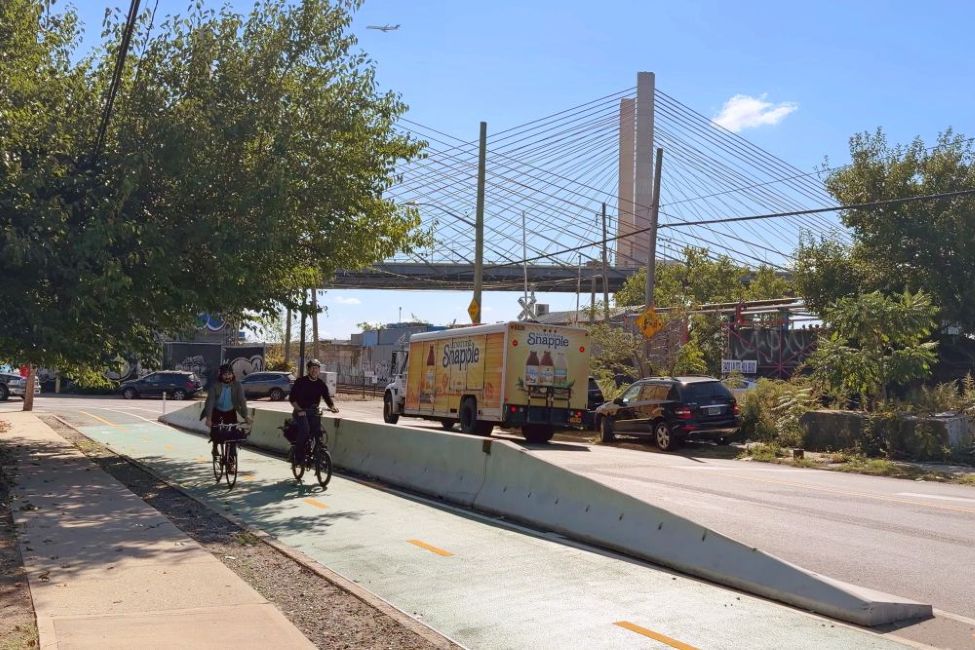
 New York City DOT, Flickr, CC BY-NC-ND 4.0
Published in 2025, NCHRP [National Cooperative Highway Research Program] Synthesis 639: Implementation of Federal Highway Administration Proven Safety Countermeasures provides a detailed examination of how state departments of transportation (DOTs) have adopted and institutionalized roadway safety strategies identified by FHWA as effective in reducing crashes and saving lives.
For decades, public safety has been a top priority for state DOTs as they work to reduce traffic-related fatalities and serious injuries. To support these efforts, the FHWA Office of Safety developed a suite of field-tested strategies shown through research to measurably reduce crash frequency and severity. The initial rollout in 2008 featured nine proven safety countermeasures (PSCs). By 2025, that number grew to 28 countermeasures grouped into five categories: speed management, pedestrian and bicyclist, roadway departure, intersections, and crosscutting. “This report sheds light on the real-world uptake of life-saving practices across the country,” notes Henry Brown, a research engineer at the University of Missouri and principal investigator for NCHRP Synthesis 639. “It provides insight into how these strategies move from federal guidance to everyday use on America’s roads.”
Assessing Implementation
Based on survey responses from 49 states and follow-up interviews with six, NCHRP Synthesis 639 investigates how FHWA PSCs are being piloted, implemented, and adopted into agency policies and procedures. It also documents the scale and frequency of implementation, internal evaluation processes, and strategies that agencies have used to overcome barriers.
Findings show that while most state DOTs have adopted many PSCs in some capacity, full institutionalization (e.g., incorporation into manuals, standards, or routine practice) varies across agencies and PSC types. PSCs such as longitudinal rumble strips and stripes on two-lane roads; median barriers; and construction of the SafetyEdge—a 30-degree-angle pavement edge that allows drivers who drift off the highway to return to the pavement safely—have seen the most widespread resource development (e.g., standards, guidelines, and training materials). In contrast, speed safety cameras and variable speed limits were among the least supported PSCs with regard to agency-specific resources.
“Twenty-eight responding [state] DOTs have developed policies, processes, or tools that explicitly consider and prioritize FHWA PSCs,” Brown adds. “But implementation patterns differ significantly, depending on the measure, context, and agency structure.”
Barriers, Modifications, and Evaluation Strategies
The synthesis identifies a variety of factors that influence the pace and extent of PSC implementation, including public acceptance, funding availability, interagency coordination, and design compatibility with existing infrastructure.
Despite these challenges, state DOTs have made significant progress by leveraging the following:
- Strategic updates to design manuals and policies
- Pilot programs and corridor-specific evaluations
- Dedicated internal safety teams or balanced task force representation
- Training programs and peer exchange activities
Several agencies also emphasized the importance of evaluating the effectiveness of PSCs after deployment—often through before-and-after crash data, systemwide safety analyses, or internal performance reporting.
Roadmap for Future Safety Practice
The synthesis concludes by identifying future research needs to further enhance implementation and impact. These include the development of new tools and data resources, expanded guidance on emerging countermeasures, and continued documentation of best practices across different state DOT environments. “The most successful implementation efforts were those that made safety countermeasures part of the everyday workflow,” says Brown. “Continued collaboration across agencies and with FHWA will be key to sustaining this progress.”