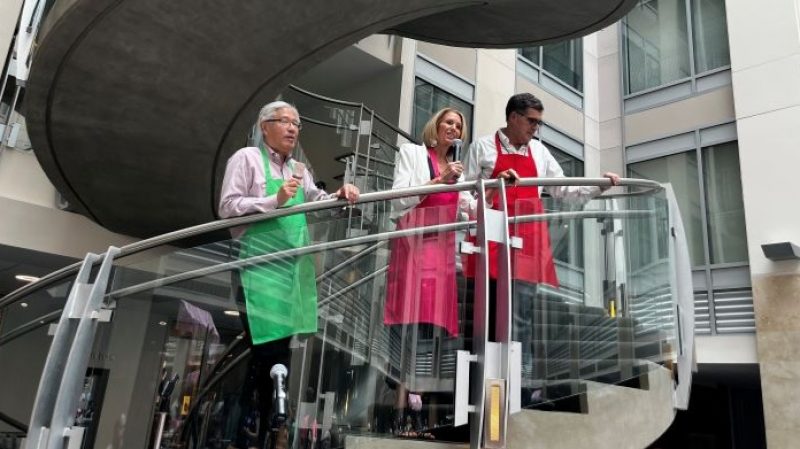

David Wilcock tackles transit challenges with the gusto of a lifelong train lover. His efforts to improve public transportation—most spanning his 36 years at Boston, Massachusetts–based VHB, where he is a principal and head of its public transportation and railroad practice—include projects in some of the nation’s most congested corridors. Among them are modernizing and expanding Greater Boston’s transit infrastructure; designing a bus rapid-transit system for Greater New Haven, Connecticut; and doubling capacity of the sole railroad bridge between Washington, DC, and Virginia to relieve one of the East Coast’s largest rail bottlenecks.
 VHB
VHBWilcock’s volunteer contributions have been just as far-reaching. An active TRB volunteer for three decades, he helped set research priorities as a member of the Transit Cooperative Research Program (TCRP) Oversight and Projects Selection (TOPS) Commission from 2017 to 2024 and currently chairs a TCRP project panel. He also is active in other organizations, including APTA, where he is the associate publisher for a quarterly newsletter on high-speed and intercity rail, and ITE, where he serves on the Grade Crossing Committee. Wilcock finds time to engage the public on transportation issues, too, whether giving talks at a local library or writing magazine articles for fans of historic railroads.
Wilcock’s interest in rail transportation dates back to his childhood in North Attleboro, Massachusetts, about an hour southwest of Boston. He fondly remembers riding with his mother on Boston’s elevated Orange Line (now subway route) to see Santa at a downtown department store. Additional inspiration lay closer to home, where Wilcock would explore the abandoned rail line near his house for glass insulators or other artifacts and read his eldest brother’s collection of Model Railroader and Trains magazines.
The biggest spark, however, may have been receiving his first train set at age four. “It seemed like everything from that point on was all about trains for me,” recalls Wilcock, who commandeered his brother’s model railroad layout in the basement and then “convinced a friend that railroads were interesting, so he joined me in the fun.”
That boyhood enthusiasm led to real-life rail adventures. When Wilcock and his friend were older, they would get a ride to the nearby train station—on the former New Haven Railroad’s Shoreline route (today’s Northeast Corridor)—and hang out, snapping photos of the railroad activity. They also took train trips. A highlight was an unchaperoned journey from Providence, Rhode Island, to Philadelphia, Pennsylvania, that let them spend time watching trains in New York’s Penn Station and Reading Terminal in Philadelphia. “We managed to get kicked out of both facilities for taking pictures!” notes Wilcock, who found all that train activity south of New York “a really eye-opening experience.”
“I view research and development as critical to the success and vitality of public transportation and railroads.”
—David Wilcock
Further eye-openers came at Northeastern University in Boston, a cooperative education program where students alternate academic studies with full-time professional experiences. Wilcock majored in civil engineering, figuring it was the best route to get into railroading. On his first co-op assignment, he worked on maintenance-of-way issues as a junior engineer for Amtrak in New Haven. “I met some crusty long-time railroaders who didn’t have a lot of use for young engineers,” Wilcock recounts. “They all, however, taught me a lot about the railroad, and one in particular gave me a firsthand tour of every part of the division.” Two subsequent co-op assignments involving systemwide ridership-survey data processing and analysis (Fortran IV and IBM punch cards!) with the Massachusetts Bay Transportation Authority’s newly created Central Transportation Planning Staff introduced him to the planning side of public transportation.
Graduating from college in 1982, Wilcock worked for the next five years as a traffic engineer in New Jersey and two Rhode Island firms, studying the need for safety improvements, preparing traffic impact statements, and designing new signaling systems. One assignment involved designing traffic signal preemption at a railroad crossing. In 1987, he joined VHB as a senior project engineer for traffic operations. Over the next 24 years, Wilcock participated in or directed multidisciplinary teams that prepared feasibility studies, impact reports, and final engineering plans, as well as public outreach, for rail and transit projects from New England to Alaska. He became a principal in 2005 and, except for a brief stint heading the railroad and transit practice of a large international consulting firm from 2012 to 2015, Wilcock built his career at VHB.
His work at VHB—which ranged from equipment evaluation to travel demand modeling and financial analyses—soon pointed him toward TRB. “I view research and development as critical to the success and vitality of public transportation and railroads,” explains Wilcock, whose first Annual Meeting in 1993 proved memorable. His paper—on a VHB study of a proposed magnetically levitated train along the Massachusetts Turnpike right-of-way from Boston to Pittsfield—was selected for a podium presentation. He was stunned at how popular the session was, with “every seat taken and people lining the walls.” Just as he started to speak, however, the lectern light winked out, plunging his carefully prepared notes into darkness. “Fortunately, I had practiced the presentation a number of times and got through it without incident,” he recounts.
Wilcock soon began volunteering on subcommittees. He went on to join the Standing Committee on Commuter Rail Transportation, serving as chair from 2006 to 2012. His interest in TCRP deepened when, as chair, he tried three times to win acceptance of a research problem on commuter rail contracting practices. It ultimately was approved, and Wilcock served on the project panel, as well as on nearly a dozen other Cooperative Research Programs projects. He currently is studying rail safety innovations as a panel member on TRB’s Innovations Deserving Exploratory Analysis (IDEA) Program and serves on one National Cooperative Highway Research Program (NCHRP) and two TCRP project panels on topics ranging from the aesthetic design of passenger platforms to grade-crossing substructures.
“The point I stress to young professionals is to find ways to become active, engaged, and indispensable to the organization,” explains Wilcock, whose TOPS Commission role provided a firsthand view of the challenges faced by the public transportation sector. Participation in TRB Annual Meetings also has provided insights on important research in the railroad industry, such as the 2026 session on the use of AI, drones, and other innovative technologies to improve track inspections while reducing cost.
Wilcock strives to unite his avocation with his vocation. “I am still very much into railroads and public transportation as a hobby,” he acknowledges, citing his collection of more than 7,000 public timetables for various passenger and commuter railroads that he began compiling as a child. Hobbies sometime prove valuable professionally. Wilcock says his timetables—most of which date from the 1950s, though the oldest, which Wilcock found in the eaves of a building he was helping to clean out, is from the 1840s—have proved useful on several projects over the years.
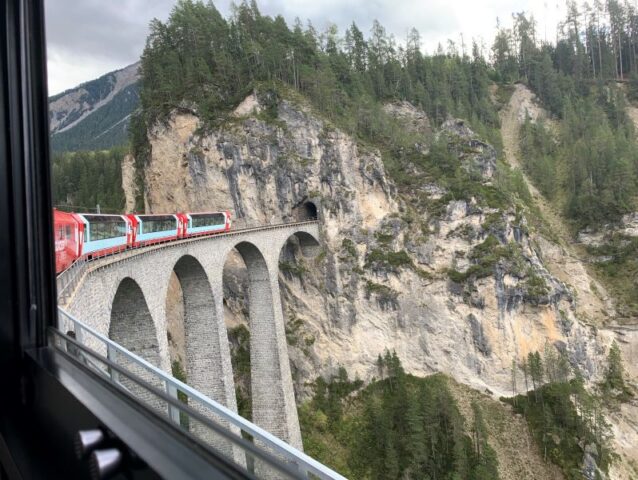
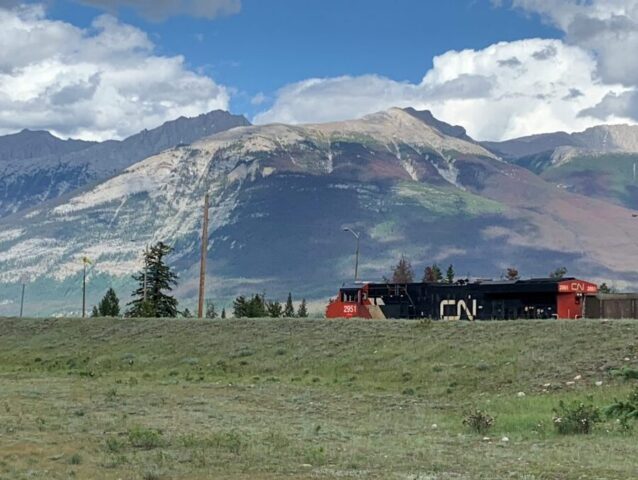
Wilcock, a member of the New Haven Railroad Historical and Technical Association and the National Association of Timetable Collectors, still relishes traveling by train. He describes a 2019 trip aboard The Canadian with his wife and another couple from Vancouver, British Columbia, to Jasper National Park and back as a return to the golden era of rail travel “as we rode in luxurious sleeping accommodations and ate delicious meals in the dining car.” In 2024, the same group took a 10-day rail tour of Switzerland. “It was amazing,” reports Wilcock. “The Swiss run their railroads like clockwork.” Best of all, he didn’t have to do the planning.
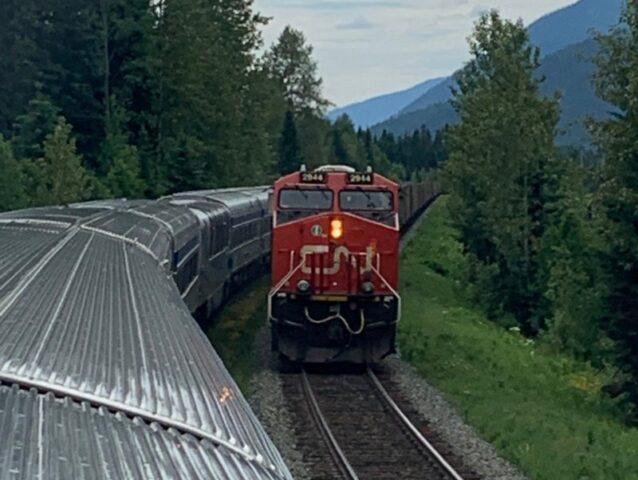 David WilcockThe Canadian Rockies from aboard the Vancouver-bound Canadian.