
 Charles Edward Miller, Wikimedia Commons, CC BY-SA 2.0
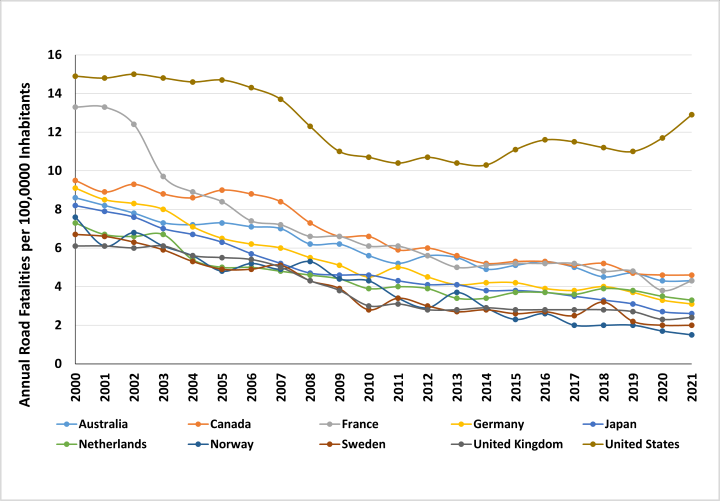
Motor vehicle death rates in the United States are about five times higher than in Australia, Canada, and Japan, as well as the safest nations in Europe (1). Do those countries have a secret formula to reduce their traffic fatalities? Does their road safety research tell them things that transportation professionals in the United States don’t know? These questions—posed by FHWA, in collaboration with AASHTO and the Insurance Institute for Highway Safety—led to the appointment of the TRB Committee on Transitioning Evidence-Based Road Safety Research into Practice and precipitated their consensus study work. That work resulted in TRB Special Report 354: Tackling the Road Safety Crisis: Saving Lives Through Research and Action.
The short answer: There are no secrets to road safety. The top-performing nations have the same initial data, the same research results, and the same professional guidance that we have in the United States. Why are their results so different? Because they have made national commitments to achieving zero highway deaths by aggressively and systematically deploying proven crash countermeasures.
Nations that have successfully reduced motor vehicle death rates have made the pursuit of zero deaths a real goal, not just an aspiration, and they track their progress toward that goal to keep their road safety programs on target. These countries have declared roadway deaths to be unacceptable, not just the cost of doing business in our automobile culture.
Possessing the same information as better performing nations, the United States has taken a different path. But why? Is it because the power to manage the roadway network resides in the states, each of which has different safety policies? Australia is a federation of six independent states, and Canada has 10 independent provinces. Yet, their roadway death rates are much lower than those of the United States (1) (Figure 1).
To address this question, the 12-member consensus study committee mapped the process through which road safety research in the United States is selected, prioritized, conducted, and disseminated to safety practitioners, as well as the way decisions to deploy crash countermeasures are made. This is the supply chain that connects road safety problems to countermeasure knowledge and interventions. To build and troubleshoot this safety supply chain, committee members reviewed research literature and policy guidance and heard from road safety experts, researchers, program managers, and law enforcement authorities in Australia, Canada, Europe, and the United States.
The committee examined each component of the supply chain, looking for places where the flow of knowledge could go awry and opportunities to deploy promising crash countermeasures could be missed.
In the safety research realm, the committee found that there are three separate and disconnected programs producing publicly sponsored road safety research: the largest, the AASHTO-sponsored National Cooperative Highway Research Program (NCHRP); the FHWA research program; and the NHTSA program focused on driver behavior and enforcement. These programs operate independently, and none is driven by a systematic and transparent research strategy. Instead, research investment decisions are made annually and separately. There is no overall national road safety research agenda; investments are not linked to road safety outcomes either as goals or as performance metrics (i.e., feedback).
Further, there is no formal research translation process that connects safety practitioners and the problems they face with the production of the research itself. This is in sharp contrast to the formalized research translation process found from a deep dive into biomedical research, for example, where there are established channels through which researchers are connected to—and understand—problems in the clinic. Researchers can explain the application and limitations of their findings to medical practitioners, and research products can be efficiently adapted to specific clinical needs. Simply stated, in medicine, researchers and practitioners communicate and work together to address and solve problems. The distance between research and practice is designed to be short to accelerate translation of interventions to practice.
In contrast, the process for generating and converting road safety findings into practitioner guidance is complicated, slow, and episodic. And guidance is issued in multiple forms (e.g., the Highway Safety Manual; AASHTO’s A Policy on Geometric Design of Highways and Streets, commonly referred to as the Green Book; the Manual on Uniform Traffic Control Devices; and many versions of state and locally adapted safety guidance). The committee found these multiple sources to be complicated and conflicting. This makes the job of the road safety practitioner a difficult one: diagnosing the problem, selecting promising crash countermeasures, finding relevant data to support the choice of appropriate countermeasures for a specific setting, and convincing decision makers to implement recommended actions. For example, the FHWA Crash Modification Factors (CMF) Clearinghouse is a searchable online database of crash interventions with their documented post-implementation crash rates in specific contexts. The CMF Clearinghouse contains almost 9,000 countermeasure/context entries (e.g., striping on two-lane rural highways and speed-limit reductions on urban arterial streets). Finding the right match for a practical situation can be difficult and, in some cases, impossible because a relevant case may not have been studied and published in the literature and then captured in the CMF Clearinghouse.
The clearinghouse includes CMFs based on data from other nations where the context—such as enforcement, road conditions, and driver behavior—may be radically different than in the United States; cases in which data are decades old in situations where roadways, vehicles, and drivers are different today; and reports in which the contextual factors are incompletely identified. Weakness in the quality of information that guides countermeasure selection leads to poor choices—or no choices.
Beyond these complicating factors, translating proven crash countermeasures into practice is stopped when a decision is made to not employ a proven intervention. This can happen because of limited funds; when safety funds have been redirected to nonsafety applications; or because a proven countermeasure is rejected for cultural or political reasons, as in, “We don’t do that here.” The latter often occurs with automated enforcement of speeding violations or running a red light, which, though well proven as crash countermeasures, are prohibited or simply rejected in some states and jurisdictions. Aggressive actions to curb alcohol-related road deaths, such as roadside stops at strategic locations and times, as well as strong penalties that result in automatic loss of driving privileges for high blood alcohol concentration levels—well-documented to be a strong deterrent in northern Europe—are sometimes rejected as infringements on personal freedoms and privacy. When a community says, “We won’t use that aggressive driving-under-the-influence [DUI] interdiction here,” it communicates that “avoidable DUI deaths are acceptable to us.”
The committee found that some state departments of transportation (DOTs) resist lowering speed limits on multiuse streets because their priority is on the free flow of traffic rather than pedestrian safety.
The committee made five recommendations aimed at improving the functioning of the road safety research supply chain by providing better information more efficiently, making the work of the road safety practitioner easier, preparing those practitioners to be more effective, and creating an integrated approach to road safety research and implementation. These recommendations were targeted at the U.S. Department of Transportation (U.S. DOT) because they address strategic road safety needs at the national level.
Recommendation 1
U.S. DOT should establish and support a collaborative and transparent process that is dedicated to defining road safety research priorities across all federally funded research programs. The priorities should be set forth in a regularly updated National Road Safety Research Agenda developed by an independent body responsible for identifying and integrating priorities informed by data-driven methods.
This recommendation calls for coordinated and focused application of all nationally funded safety research [which totaled more than $150 million for FHWA, NHTSA, NCHRP, and the Behavioral Traffic Safety Cooperative Research Program (BTSCRP) in 2023 (2)], selecting research investments based on a consensus of national priorities that address the interests of all road users: motorized and nonmotorized vehicle operators, as well as host communities. Priorities should be based on data that reflect current and emerging safety problems on the U.S. road network, critical knowledge gaps, and performance of past road safety research products. The process, as well as the research agenda, should be transparent to the nation and regularly evaluated and updated. Development of an integrated focused, safety research agenda was recommended by a 2008 TRB study but not implemented (3).
Recommendation 2
U.S. DOT should establish a program to support rigorous, ongoing evaluations of the effectiveness of new and commonly deployed crash countermeasures.
While FHWA and NHTSA issue lists of proven crash countermeasures, the level of proof varies across these lists, and for some recommendations the effectiveness claims are particularly weak. There is a need to cull these lists, identify promising or commonly used countermeasures that lack reasonable evidence of effectiveness, and cycle these countermeasures back to a quality research effort to evaluate their effectiveness. Legacy countermeasures and analysis procedures that have been superseded should be removed from practitioner guidance. This includes countermeasures that are supported by data coming from outdated motor vehicle characteristics and driver behaviors. The need to review the effectiveness of crash countermeasures is ongoing. The current pooled fund study on the effectiveness of low-cost countermeasures is a model that can be expanded into a more broadly focused effort.
Recommendation 3
U.S. DOT should integrate and harmonize the key guidance practitioners use to inform their selection of crash countermeasures.
The committee’s review of the safety guidance supply chain showed that practitioners are confronted with a large volume of complicated and sometimes conflicting guidance in the choice of crash countermeasures. Multiple states, municipalities, and professional organizations have developed their own guidance workarounds to address important issues and make the task for safety professionals more efficient and effective. The collection of crash countermeasure guidance has grown by accretion. It is important and timely to harmonize this guidance into a unified, accessible, and readily updated package to lower the barrier to efficient road safety investment analysis and decision making.
Recommendation 4
U.S. DOT should sponsor the development of curricula for road safety education and training for academic, as well as professional, development programs.
Lack of a sufficiently prepared road safety workforce is a barrier to making good and quick investment decisions about crash countermeasures. A key weakness is the educational process that brings practitioners—primarily engineers—into the transportation workforce. The committee found that road safety training in typical civil engineering undergraduate and graduate programs can be absent or superficial. The availability of a model curriculum would facilitate the integration of safety analysis and design skills into educational programs. Topics could include data collection and analysis, road safety audits, sources of guidance on countermeasure selection, design principles, and evaluation tools. These materials could be developed and disseminated by professional organizations or contractors.
Recommendation 5
To implement the recommendations in this report, U.S. DOT should consider standing up (i.e., establishing) a fully functioning national road safety research center, seeking the needed resources from Congress as appropriate.
Throughout its two years of research and deliberations, the committee confronted the dispersed and fragmented approach to road safety in the United States. Fragmentation is obvious in research, guidance, evaluation, and countermeasure recommendations. To address this, the committee urged the federal government to accept the idea that current motor vehicle death trends are a crisis in the United States, reduce duplicative and conflicting efforts, and maximize the effectiveness of the assault on traffic deaths by bringing these efforts together in a national road safety research center. This might be a contracted entity—much like the U.S. Department of Energy’s major laboratories—that would host and sustain the development of a national road safety research agenda; undertake or contract for research; take on the tasks of rationalizing road safety guidance; and become the focal point for developing, certifying, and disseminating analysis tools.
The center would be the leader in the national effort to drive motor vehicle deaths to zero. Its activities would be transparent and collaborative, bringing to the table representatives of all road users through a board of directors that includes federal, state, and municipal interests; the motor vehicle and infrastructures industries; universities; and representatives of the full spectrum of road users and road neighbors.
 Mary Lord, TRB Staff
While the work of the committee was aimed at its national sponsors and led to these five recommendations, the committee found much valuable information that could help safety professionals at the state and municipal levels reduce motor vehicle deaths immediately. Among these ideas are the following:
- Every road improvement project is an opportunity to improve safety. All federal highway funds may be used for safety enhancements, not only Highway Safety Improvement Program money. Each time a road segment is considered for improvement is an opportunity to enhance its safety performance. This is a way to make safety a mainstream program goal.
- Make the Safe System Approach (SSA) the guiding principle for managing the road network. The SSA commits to the policy that traffic deaths and serious injuries are unacceptable. It aims to protect road users from making mistakes—not blame them. SSA is a proactive method for reducing crashes, identifying and addressing safety issues before crashes and deaths occur. For example, road safety audits are proactive tools for this purpose. SSA calls for road designers and managers, vehicle designers, law enforcement officials, and first responders to work together to eliminate deaths. Transportation agency safety experts should not work in isolation but should seek out and deploy integrated responses to crash risks.
- All road users count in safety design and decision making. This means that motor vehicle operators, users of nonmotorized and lightly motorized vehicles (e.g., electric bicycles and scooters ), and pedestrians should be appropriately considered in designing, redesigning, and operating the roadway network. The objective should not be to maximize speed or throughput subject to safety constraints but to maximize roadway performance to include capacity and safety for all road users.
- Employ evidence-based countermeasures backed by rigorous statistical analysis. Practitioners need to conduct careful searches for the strongest countermeasure for a given context rather than just going by the book and applying a standardized response. This also means not relying on legacy tools such as setting speed limits based on the observed 85th percentile speeds when strong, safety-driven criteria are available. In some cases, the most effective interventions may meet resistance from the community. These include the substitution of roundabouts for some intersections and deploying various forms of automated enforcement. Pushback on ubiquitous and aggressive traffic enforcement techniques is common. However, the social costs of such violations are high, and decisions to exclude aggressive enforcement often fail to recognize those costs.
- High-quality evaluation should be part of any significant deployment of crash countermeasures. This means careful data collection and the use of strong statistical designs. A good evaluation confirms (or denies) the efficacy of the countermeasure, builds the local knowledge base for future decision making, and captures the value of local innovation and experimentation.
 Courtesy of Wisconsin DOT
The committee’s report suggests that the United States can finally end deaths on its highways, bringing death rates in line with comparable international levels and eventually driving them to zero. To do this, road safety professionals and policy makers need to commit to the policy that roadway deaths are unacceptable. Federal agencies must work together, not independently, to solve this problem. Safety professionals should rationalize the guidance provided to practitioners and the process that produces it. And at state and local levels, all must use the best knowledge to deploy those crash countermeasures that are known to work.