
 Petty Officer 3rd Class Edward Wargo, USCG District 8
This article is partially derived and excerpted from TRB Special Report 350: Reforming the Coast Guard’s Certificate of Compliance Program for Liquefied Gas Carriers: Promoting Efficient Implementation and Safety Effectiveness.
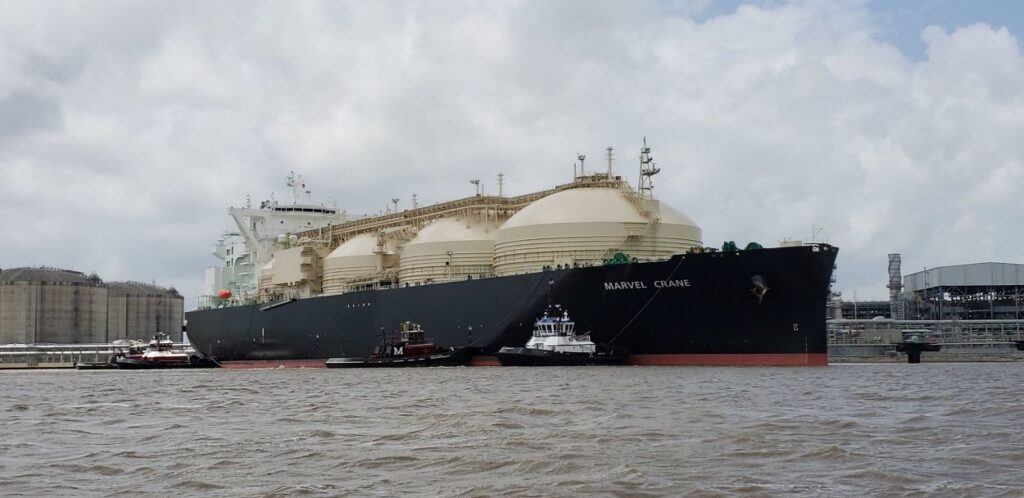
Liquefied gas exports from U.S. ports have grown rapidly in recent years, resulting in the need for reforms to the U.S. Coast Guard (USCG) program that examines liquefied gas carriers (LGCs). Such growth is likely to increase the demand for gas carrier examinations by USCG marine inspectors, of whom there is a chronic shortage. In addition, foreign LGCs arriving from overseas ahead of their assigned times for cargo operations could outpace the ability of USCG’s gas-qualified inspectors to conduct the required exams in a timely and thorough manner.
In 2021, Congress—concerned about the shortage and other inspection challenges—requested that the National Academies study USCG’s ability to address the growth in liquefied gas exports, as well as the safety compliance of associated foreign tank ships when loading these exports for transport overseas. The consensus study committee’s efforts resulted in TRB Special Report 350: Reforming the Coast Guard’s Certificate of Compliance Program for Liquefied Gas Carriers: Promoting Efficient Implementation and Safety Effectiveness.
Types of Vessels Examined and Why
All foreign commercial vessels that call on U.S. ports are subject to periodic Port State Control examinations conducted by USCG marine inspectors. In addition, specialized vessels—such as tank ships—are required to undergo an annual Certificate of Compliance (COC) exam that includes an added layer of statutory requirements for tank ships. Conducting COC exams is a small but important part of USCG’s overall marine inspection responsibility. These exams are unique to the United States and are conducted by USCG marine inspectors with specialized qualifications for gas carriers. A vessel that passes a COC exam is granted a certificate that is valid for two years, but it must also undergo an intermediate exam one year into the two-year term to maintain the certificate’s validity.
Study Considerations
Congress proposed several options for consideration in this study, each intended to maintain USCG’s ability to implement the COC program efficiently while maintaining its safety role as growth in gas exports and LGC traffic increases. The committee was asked to recommend a course of action based on Congress’ proposed options and review other promising ideas. To do so, the committee examined liquefied gas export trends and LGC traffic forecasts, USCG’s methods for implementing the COC program, and reasons that efficient implementation can be critical to gas export operations. In addition, the committee considered how the COC program fits within the broader USCG, international, and industry regimes for assessing and verifying the safe condition and operations of LGC foreign cargo vessels.
Committee Conclusions
The committee concluded that COC program reforms for LGCs are indeed needed. Growth in liquefied gas exports and LGC arrivals is likely to increase the demand for gas carrier COC exams over at least the next decade. The chronic shortage of USCG marine inspectors trained for LGCs presents a challenge for keeping pace with demand for these exams. The committee also concluded that reforms should be possible without jeopardizing the program’s safety assurance effectiveness, since a comprehensive, international, and collaborative regime for assuring LGC safety emerged during the advent of the COC program in the 1970s. Greater reliance on risk indicators to guide the frequency and scope of COC exams for gas carriers could be an initial step for USCG, with support from staff at the Liquefied Gas Carrier National Center of Expertise—who provide professional training and input to the development of USCG gas carrier inspection practices.
Some of the committee’s specific recommendations to Congress and USCG include extending the COC’s validity term to five years (in alignment with the duration of major international certificates), as well as enhancing its current Port State Control risk assessment and vetting capabilities.