
 Mike Pinard
Low-volume roads (LVRs) can be paved or unpaved and typically carry fewer than 200 vehicles per day, including nonmotorized traffic near populated areas. They are vital components of the international road system, particularly in developing regions, where they play a crucial role in the economic and social development of rural communities. Unfortunately, the people in many such communities remain trapped in poverty because they do not have basic road access—limiting their ability to reach food markets, schools, health centers, water sources, places of worship, and other locations for community gatherings. Lack of access to these amenities is a defining characteristic of poverty. Consider the following statistics:
- About 1.2 billion people worldwide lack access to an all-weather road.
- In developing countries, an estimated 40 to 60 percent of the population live approximately five miles (more than eight kilometers) from a paved road.
- In some developing countries, less than 15 percent of the roads are paved (1).
By necessity, LVR builders use resourcefulness to develop solutions suited to their needs. This article highlights such innovations and recent LVR technology advances that make road construction more affordable and sustainable while effectively managing risks.
Use of By-Product Materials
In many rural regions of developing countries, LVR innovations start with the use of sustainable local materials. Research conducted under the South East Asia Community Access Programme in Vietnam led to the development of fired clay brick paving that incorporated rice husks as an innovative alternative surfacing technology for LVRs, which reduced reliance on fossil fuels through the use of bitumen (2). Such brick pavements were also found to be more cost-effective than cement concrete. They can be constructed using local skills without the need for heavy equipment such as graders or rollers. Additionally, they are durable, require minimal maintenance, and can be easily repaired by replacing broken or damaged bricks.
Construction
Natural gravels—commonly found in rural areas of many developing countries—are sufficiently durable materials for LVR construction. However, a key factor in using natural gravels effectively is maximizing their strength, stiffness, and bearing capacity through adequate compaction. Instead of compacting to a predetermined relative compaction level, as traditionally specified, the goal is to achieve the highest uniform density possible without degrading particle strength—a process known as “compacting to refusal.” This approach significantly increases density and stiffness, with benefits that generally outweigh the additional cost of extra roller passes.
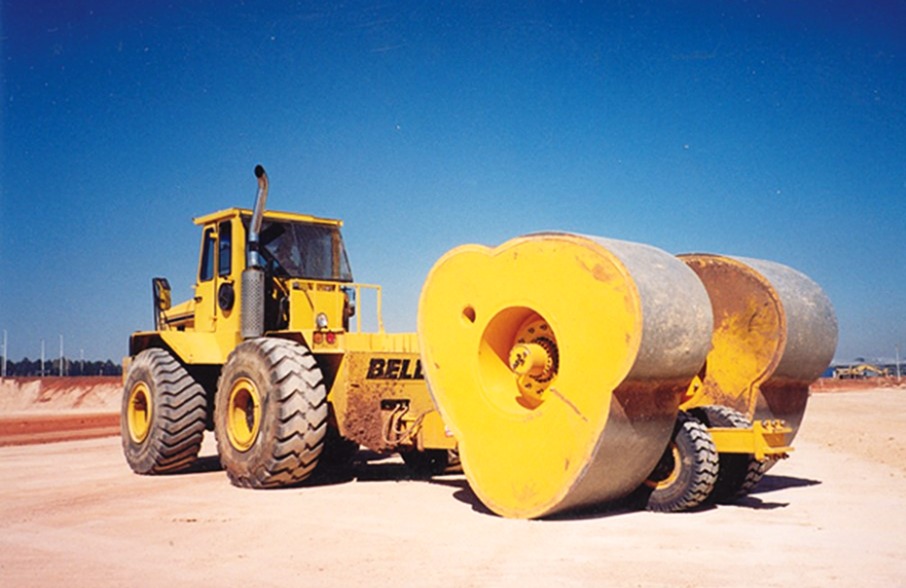
In many countries, particularly those with arid or semiarid climates, water for construction is scarce; it is either located at great depths or must be hauled over long distances. To address this challenge, researchers examined an alternative compaction approach that utilized noncircular impact compactors. Extensive trials in Botswana led to the development of an innovative technique that uses a three-sided, 35-kilojoule, high-energy impact compactor to achieve deep compaction of sandy subgrade and upper pavement layers. This method allows for material to be compacted in relatively thick layers without the heavy water requirements of conventional rollers, resulting in substantial cost savings.
Maintenance
Effective and timely maintenance is essential for preserving investments in LVRs. However, road maintenance funding must compete with other economic priorities, and the allocated budget is often severely inadequate. Thus, it is important to use available funds as effectively as possible, including the adoption of appropriate equipment and techniques.
To make the best use of the limited funds available for road access in developing countries, practitioners should ideally embrace innovative approaches. Achieving this requires challenging outdated paradigms that stem from research carried out more than 50 years ago in environments vastly different from those in developing countries. Although these approaches may suit high-traffic primary—or trunk—roads, they are frequently unsuitable and unsustainable for rural roads, where traffic volumes seldom exceed 300 vehicles per day in both directions.
“The body of highway engineering knowledge remains empirical rather than rigorously scientific. So, the knowledge taught in our universities is generally derived from a synthesis of local [UK and U.S.] experience. No wonder it is often irrelevant and sometimes downright misleading in other parts of the world.” (3)
—Ray Millard, Highways Adviser, World Bank
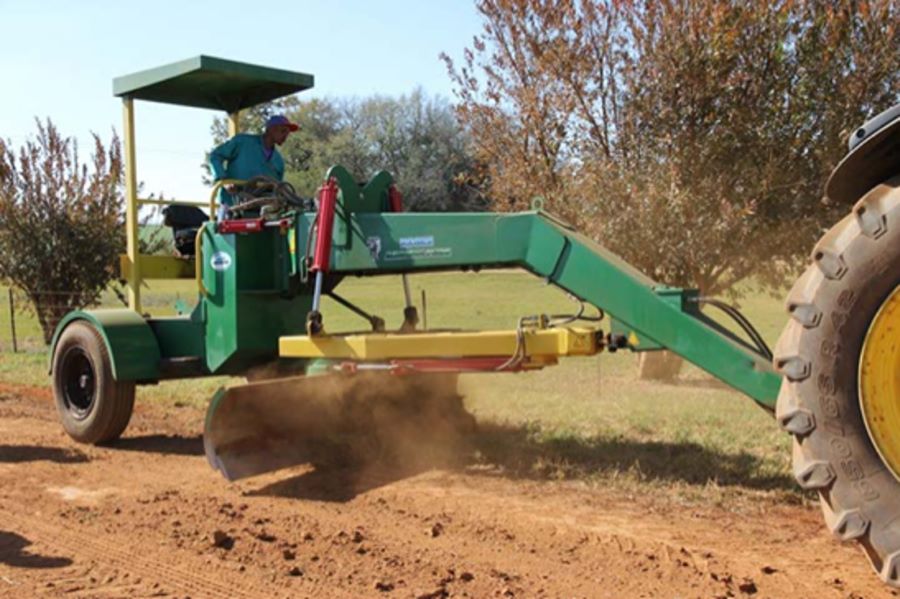
Traditionally, gravel road maintenance has relied on motorized graders, which are costly to own, operate, and maintain. This heavy equipment approach has consistently failed as a sustainable method for road construction and maintenance in many developing countries. More affordable alternatives—such as tractor-towed graders and tires dragged behind tractors on LVRs—have proven to be effective at up to 40 percent lower costs than traditional motorized graders (4). These approaches have also been successfully implemented in several countries in southern Africa.
 Rob Petts, Intech Associates
Recyclable Materials for Roads
Researchers once considered waste products such as crushed glass, tires, and industrial slag to be unusable for LVR construction. However, some recyclable materials offer the potential to deliver significant benefits, including saving costs, reducing landfill use, and protecting the environment. Besides the previously listed products, typical waste materials used in constructing LVRs include the following:
- Recycled plastic
- Reclaimed asphalt pavement
- Coal combustion products
- Recycled crushed concrete and masonry
What Goes into LVR Design?
LVR design is influenced by the following specific factors:
- Roads are constructed mainly from naturally occurring, often nonstandard, moisture-sensitive materials that may not meet traditional specifications but have proven to be suitable for their purpose.
- Standard test methods that evolved from experience with temperate-zone soils do not always reliably predict the performance of locally available materials when used in road construction.
- Pavement deterioration is driven primarily by environmental factors, particularly moisture; traffic load plays a secondary role. Effective drainage is, therefore, paramount.
- For very low traffic levels, the road alignment may not be fully engineered, with most sections following existing pathways. Therefore, designers must prioritize road safety.
- Nonmotorized traffic—such as bicycles, carts, and pedestrians—may need to be accommodated, especially in urban and peri-urban areas (i.e., communities with rural characteristics on the outskirts of urban areas), with a focus on appropriate road safety measures.
- Travel speeds—dictated by vehicle types and terrain—vary but seldom exceed roughly 40–50 miles per hour (60–80 kilometers per hour).
These factors require customized test methods and a balance between managing traffic and environmental deterioration at the lowest cost over the life of the LVR. This has led to an environmentally optimized design approach, which considers road environment factors and is often more challenging than designing high-volume roads, which are built using standardized materials such as crushed stone, cement-stabilized gravels, and hot-mix asphalt.
“I have always felt that it is easier to design a pavement for a high-volume rather than a low-volume road. On the low-volume road, we continuously strive for low cost, which makes our design extremely sensitive from the standpoint of thickness, quality of pavement and surfacing materials, geometric design, and many other factors.”
—Eldon J. Yoder, Professor of Transportation Engineering, Purdue University, 1949–1983
Design of Paved Roads
Efficiently upgrading unpaved roads involves maximizing the use of existing materials and adding only minimal new layers—as needed—for traffic requirements. The use of innovative technological devices—such as the dynamic cone penetrometer—enable quick, in situ assessment of material quality and moisture, eliminating the need for extensive excavation or traditional California Bearing Ratio (CBR) sampling and enabling statistically sound pavement design. This economical method provides continuous strength measurement, addressing variability and supporting robust pavement design.
Research from more than 1,100 South African sites has led to the development of a design method based on the use of the dynamic cone penetrometer for traffic loads of up to one million standard axles. The result is significantly lower construction and maintenance costs, making the transition from gravel to paved roads economically feasible at lower traffic thresholds than previously thought.
Unpaved Roads
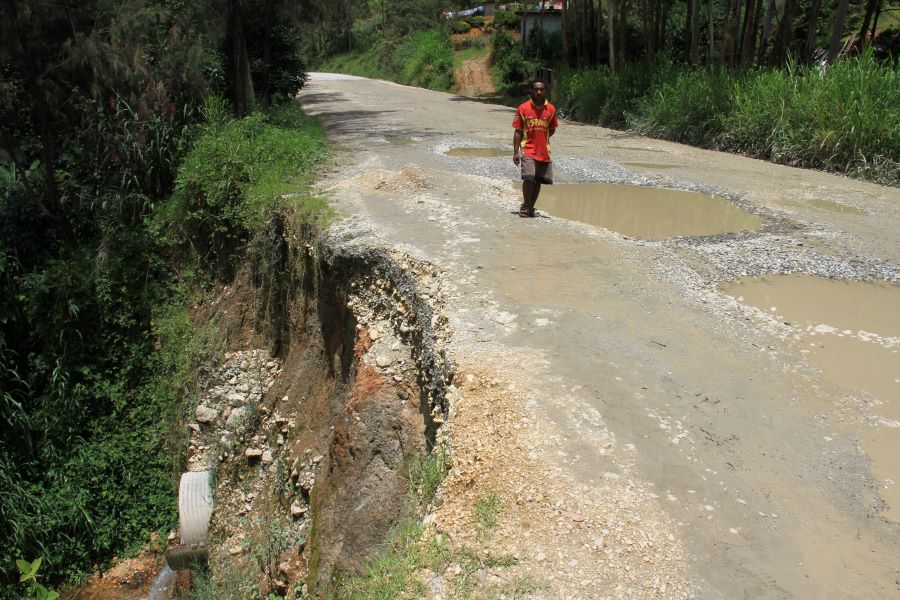
In most developing countries, unpaved roads comprise the largest portion of the classified road network. Despite their critical role in providing basic access, they are often poorly designed, inadequately constructed, and rarely maintained. To address this problem, South Africa’s Council for Scientific and Industrial Research (CSIR) conducted research on the performance of gravel roads, leading to the development of a gravel selection chart—based on compliance with two basic properties related to the material’s grading and plasticity. Meeting these requirements may be achieved by changing the material’s properties, either by blending with other materials or by removing oversize particles to improve performance.
 David Jones, University of California Pavement Research Center, Davis
Surfacing
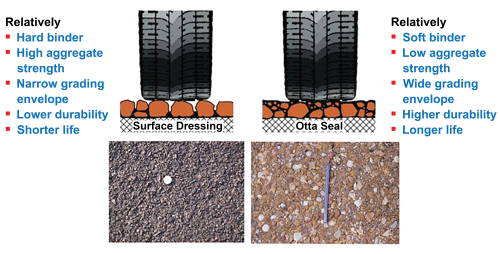
The traditional bituminous surfacing used on LVRs is chip seal surface dressing. However, this method has stringent material requirements, including the use of crushed aggregate with relatively high strength, a cubical shape, and low dust content. But what if these requirements can only be met by hauling materials over long distances? An alternative is the Otta seal, a graded aggregate that allows for the use of rounded or subrounded aggregate and higher dust content (Figure 1). Developed by Nordic Road and Transport Research and named for Norway’s Otta Valley, this technological innovation was pioneered in Botswana—where high-quality aggregate was largely unavailable in the country’s western districts.
Cold-mix asphalt seal is another variation, which—in addition to the advantages of the Otta seal—is labor friendly, requiring simple equipment and creating valuable employment opportunities for local workers.
Research Initiatives
Over the past 40 years, extensive research in tropical and subtropical countries—conducted by organizations such as the UK’s Transport Research Laboratory, South Africa’s CSIR, and Nordic Road and Transport Research—has challenged conventional understanding of material properties and pavement performance. These findings include the following:
- Standard indicator tests, such as grading and plasticity, do not strongly correlate with road performance.
- Many road bases that failed standard laboratory CBR strength requirements still performed well in practice.
- Most pavement failures were caused by surfacing defects (e.g., potholes and cracks) on unmaintained roads rather than structural issues.
- No single material property can predict LVR performance without considering drainage, compacted density, overloading, and maintenance.
Using Local Materials
Materials typically account for about 35–40 percent of LVR construction costs. Maximizing the use of local, naturally occurring materials is essential for cost savings. Unfortunately, some specifications preclude the use of materials that have been proven effective in practice, raising questions about the relevance of conventional testing methods, as well as hindering the more widespread use of local materials. The art of the engineer lies largely in using technologies that allow these professionals to work with materials available near the road. To optimize the use of local materials, a better understanding of their fundamental properties and behavior is necessary.
Testing Local Materials
Traditional material suitability assessments have relied on the CBR test (developed in the 1950s), despite well-documented concerns about its reliability. An alternative test—based on the dynamic cone penetrometer—provides a more reliable measure of material strength and is better suited for evaluating local materials in LVR construction.
Conclusion
Building an LVR requires developing ingenuity, executing innovation, working with nature, and maximizing local—often nonstandard—resources, as well as encouraging community involvement. Embedding research results into policy is essential for implementing sustainable road-building practices. When properly engineered, LVRs reduce transportation costs, drive socioeconomic growth, and help lift rural populations out of poverty in developing countries.
Resistance to Change
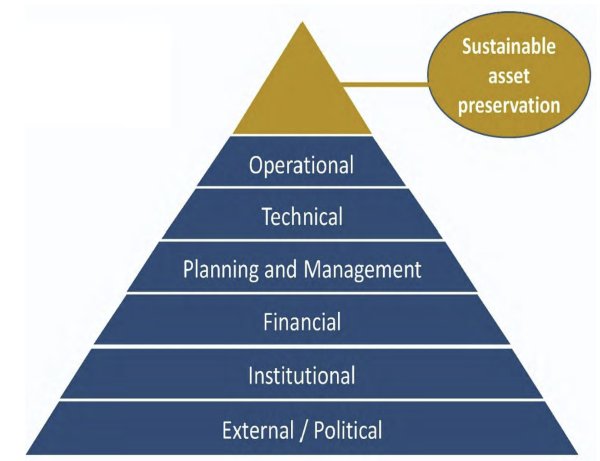
The adoption of new technology is often met with strong resistance, particularly when it challenges long-established procedures for designing, constructing, and maintaining LVRs. Overcoming this resistance entails addressing several interdependent factors, all of which must be supported by appropriate policies that integrate research results as a foundation of development. These factors may be conceptualized as a road preservation pyramid, in which the base of the pyramid represents policy—emphasizing the importance of building policies before roads. After that, the other critical building blocks of the pyramid must be addressed in hierarchical order: Institutional, Financial, and so on (Figure 2). Without a strong policy foundation, the introduction of innovative technologies is unlikely to succeed or achieve long-term impact. Until the external and institutional frameworks are improved, it is difficult to overcome the financial, technical, and operational problems that frustrate the adoption of innovative technologies in practice.