

 Douglas Eisinger
This article is partially derived and excerpted from a series the author posted on LinkedIn in 2023.
If you live in the United States, odds are you don’t drive an electric vehicle (EV)—at least not yet. Today, nearly all the vehicles on U.S. roads are gasoline- or diesel-fueled (1). Even in California, where more EVs are sold than anywhere else in the nation, only about 5 percent of all on-road passenger vehicles are fully electric (2). But what is it like to switch to an EV? As an air quality professional focused on sustainable transportation, I was thrilled when our family purchased our first fully electric vehicle in 2023. Yet, despite my transportation expertise, I was surprised at how much I learned about EVs after buying one. This article draws on those lessons to demystify EV ownership and help those considering this kind of vehicle.
I see many reasons to own an EV. Among them: EVs are central to reducing air pollution. For instance, the International Council on Clean Transportation in 2025 determined that “an ambitious EV transition, accelerated fleet renewal, and clean electricity to power EVs” would, by 2040, reduce air pollution and avoid nearly two million premature deaths worldwide (3).
As a transportation professional and EV driver, I find owning an EV remarkable. It is outstanding to drive an exhaust-free vehicle and replace gas station trips with at-home charging. My enjoyment is not unique. In a 2025 survey of EV owners, nearly 92 percent said their next car will likely be an EV (4). In the sections below, I share practical tips, explain EV driving range and charging, and discuss EV adoption challenges. I also share an unexpected detour in our EV driving experience.
 Douglas Eisinger
Battery-Management Tips
Widely accepted battery-management guidance is still emerging and difficult to find. My research yielded the following practical tips to optimize EV battery longevity:
- Keep the battery 30 to 80 percent charged. Avoid charging the battery to 100 percent, except infrequently, and recharge often enough to keep the battery ideally above 30 percent—or 20 percent at a minimum. Research shows that when charge states fall below 20 percent or rise to 100 percent, battery degradation can occur. For example, exceptionally low or high charge states can reduce the battery’s ability to store energy (5, 6).
- Avoid deep discharges. Charge often enough to avoid using a large portion of battery capacity between charges. For example, it is better to recharge five times from 40 to 60 percent than to charge once from zero to 100 percent. Recharging from 40 to 60 percent also keeps the overall state of charge (i.e., remaining capacity) at around 50 percent, which may optimize battery health (7). Research shows that deep discharges can speed battery aging and reduce its ability to store energy, while reaching zero-percent charge can permanently damage the battery (8).
- Use alternating current (AC) chargers for routine needs. Use direct current (DC) fast chargers sparingly, such as on long trips (9, 10).
- Avoid temperature extremes. Avoid high heat when parked and low and high temperatures when storing or garaging EVs for more than a few days (8). Temperature extremes change the speed of the chemical and physical reactions that make the batteries work, so vehicles may take longer to charge and temporarily experience reduced range (11).
- Manage battery charge when parking long term. If an EV is unused for an extended period, the battery likely will need to be kept between 50 and 80 percent charged. To find the proper charge level, check the automaker’s recommendation. These can differ widely, according to an examination of 11 automakers’ recommendations. The researchers noted that most EV owners who left their vehicle at an airport or parking lot while away on a trip had no trouble upon their return, provided they had charged the vehicle 50 to 80 percent before the trip (12).
Effective Range
Most consumers pay close attention to range when purchasing an EV (13). For model year 2023, the average new EV had a range of about 300 miles—roughly four times that of a 2011 EV (14). How should EV buyers think about range? EPA rates each EV’s range, but the ratings are an imperfect gauge. An additional perspective is a concept called “effective range,” which I define as the distance an EV can be routinely driven before recharging. The following steps illustrate how to estimate effective range, using our family’s vehicle, which has an EPA-estimated range of 303 miles:
Step 1. Establish 100 percent–charged range.
EPA’s ratings generally assume that 55 percent of driving takes place in the city and 45 percent on the highway (15). EV range is higher with city driving, where regenerative braking recharges the battery. Since the COVID-19 pandemic, I no longer commute to an office and do very little highway driving. My vehicle’s computer estimates that my range—based on my actual driving (as opposed to EPA assumptions)—exceeds 340 miles at 100 percent battery charge.
Step 2. Account for a potential decline in battery capacity.
Like lithium-ion batteries in other devices, EV battery capacity can degrade over time (think smartphones). An EV data analytics company forecasts that my EV’s range may decline by 10 to 20 miles when the odometer reaches 20,000 miles, after which its range should remain stable for many years (16). Assuming my range started at 340 miles, it might dip to roughly 320 miles.
Step 3. Account for charging to only 80 percent.
Numerous sources recommend that for everyday use, EVs should be charged to only 80 percent of battery capacity. My EV’s phone app lets me limit charging to 80 percent to “optimize for battery longevity.” Assuming my range at 100 percent charge is 320 miles, as calculated in the previous step, at 80 percent charge it is 256 miles.
Step 4. Factor in recharging before the battery falls below 20 to 30 percent charged.
Multiple sources suggest not letting battery charge fall below 20 to 30 percent. Let’s assume, conservatively, that I don’t allow the battery charge to fall below 30 percent. That leaves my vehicle with a remaining range of 96 miles (based on 320 miles at 100 percent charge).
Step 5. Calculate effective range.
My vehicle’s effective range—the distance I can drive without recharging—equals the brand new vehicle’s 100 percent–charged range of 340 miles, minus the following:
- 20 miles—the decline in the first 20,000 miles (Step 2).
- 64 miles—the upper 20 percent of the range I won’t access by limiting charging to 80 percent (Step 3).
- 96 miles—the bottom 30 percent of the range I won’t access given the point at which I plan to recharge (Step 4).
Thus, based on my intentionally conservative calculations, my effective range is 160 miles.
At first glance, that effective range seems low. However, U.S. drivers average no more than 30 to 35 miles per day (17). Moreover, for the occasional long trip, EVs can be charged beyond 80 percent, though the need to do so should decline as more chargers become available. In 2023, after buying our EV in Los Angeles, we started our 400-mile journey home with an 80 percent charge and drove without difficulty to northern California, recharging to 80 percent three times at fast-charging stations.
A note about heating and air conditioning: Sustained use of climate controls lowers range, an important point in some regions, especially colder ones (18). When calculating EV range, EPA incorporates reductions into its ratings formula to account for climate system use and aggressive driving.
For me, range has been a nonissue. I comfortably drive my EV, with its EPA-rated range of 303 miles and conservatively estimated effective range of 160 miles, recharging as needed. I typically drive fewer than 20 miles per day. However, even if I drove the U.S. average of 30 to 35 miles per day, my EV’s effective range would easily meet routine needs.
 Ken Fields, Flickr, CC BY-SA 2.0
Charging Insights
Charging minutia seems arcane until you own an EV. This section, which taps numerous sources and my experience of charging at home, explains the jargon and shares insights. (Fair warning: Do not overuse fast chargers.) Our family lives in single-unit housing, which enables home charging. Charging options are still in short supply for those in most multifamily housing situations.
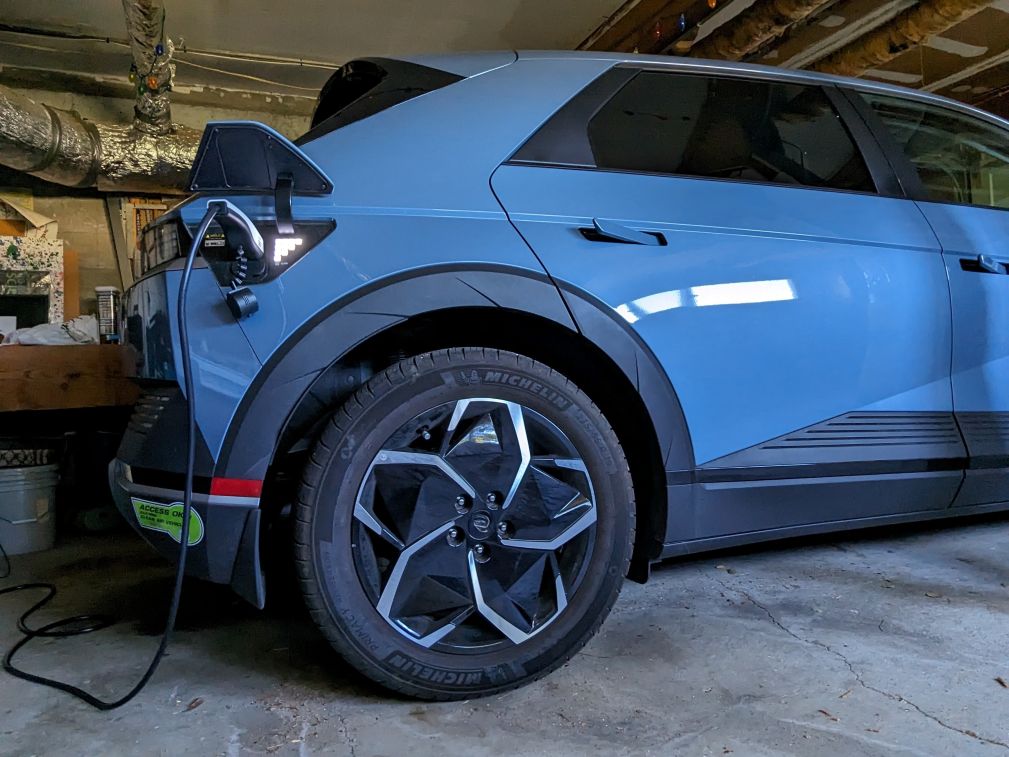
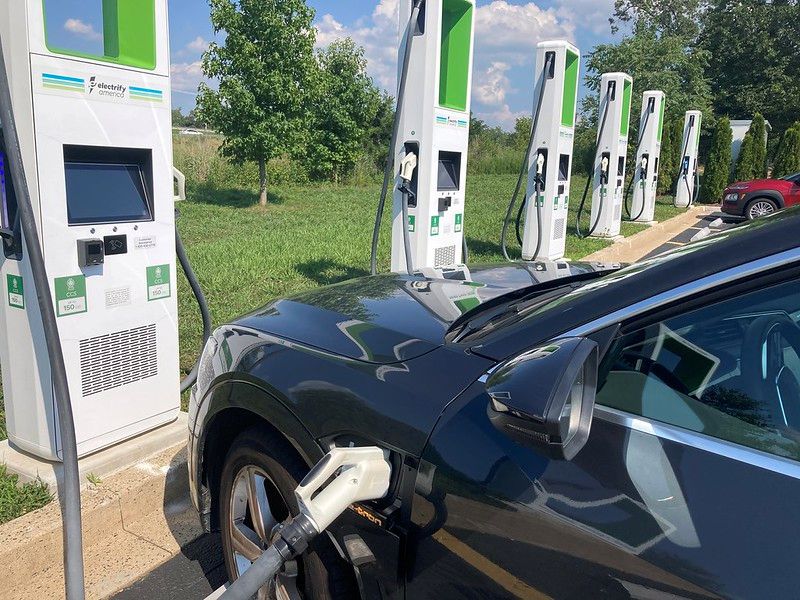
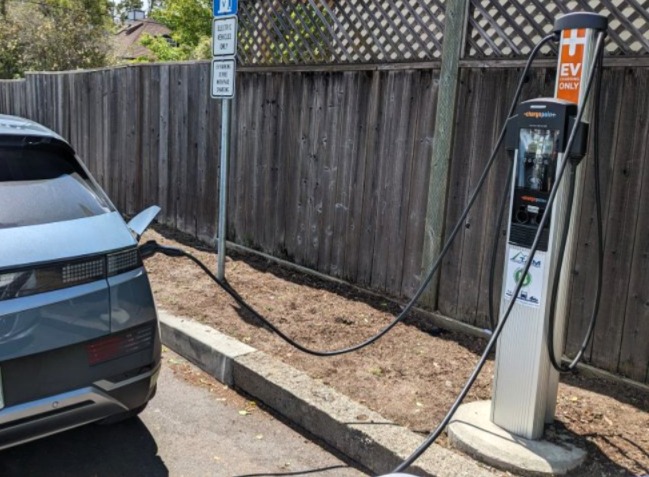
For those new to EVs, there are three types of chargers, referred to as Levels 1, 2, and 3. Levels 1 and 2 use AC, and Level 3 uses DC. In the United States, a Level 1 charger plugs into a 120-volt outlet, such as a wall plug at home. The Level 1 charger and outlet in my garage take about 12 hours to charge my EV from 65 to 80 percent, extending my driving range by 50 miles. Level 2 chargers can be installed at home using a 240-volt connection—like an electric clothes dryer outlet. They are also installed in public settings such as parking garages and shopping malls. Level 3 fast chargers provide higher power output, typically from 50 to 350 kilowatts (19). At a 350-kilowatt charger, my battery charged from 40 to 80 percent, adding 130 miles of range, in 16 minutes.
 Douglas Eisinger
The following are tips for charging:
- Rely on Level 1 or Level 2 chargers for routine needs. Frequent Level 3 fast charging may degrade long-term battery performance—cautionary advice that automakers often fail to share (8). My EV owner’s manual warns that “battery performance and durability can deteriorate if the DC charger is used constantly. Use of DC charge should be minimized in order to help prolong high voltage battery life.” An EV data analysis and advocacy group puts it this way: “DC fast charging is the double bacon cheeseburger of charging: great on a road trip but best to avoid every day” (16).
- How much fast charging may degrade batteries is unclear—and could be minimal. As an EV owner, I want to make an informed choice about how often to use fast chargers. Unfortunately, widely accepted rules of thumb that link fast charger use and battery impacts are not yet available (20). As my dealership’s staff noted, DC fast charging is too new to provide long-term insights on battery degradation. Another EV dealership estimates that fast charging more than once or twice a day could cost about one percent of battery capacity per year (5). The good news about fast charging? In 2024, an EV research and advocacy company evaluated data from 13,000 vehicles from one automaker and found “no statistically significant difference in range degradation between fast charging more than 70 percent of the time and fast charging less than 30 percent of the time.” The report said that drivers “may still want to save high voltage charging for road trips” and suggested avoiding fast charging when the car battery is “very hot, very cold, or at an extreme state of charge—such as 5 percent or 90 percent” (21).
- Fast chargers may work inconsistently. A 2025 survey found that EV owners “experience a problem at 1 out of every 5 public charging sessions they initiate.” One exception is an EV charging network set up by one manufacturer that was reported to have 96 percent reliability (22), a factor contributing to the adoption of such charging technology by other automakers. According to one forecast, “by the end of 2025, nearly all EVs will have access to some of these superfast EV charging stations” (23). In May 2025, my car’s manufacturer offered me a free adapter so my vehicle would have access to this reliable fast-charger network. Regardless of fast-charger reliability, which is improving, EVs simplify driving for those who can charge at home. It is far more convenient to plug in than to drive to a gas station.
Key Challenges
In NCHRP [National Cooperative Highway Research Program] Web-Only Document 274: Zero Emission Vehicles: Forecasting Fleet Scenarios and Their Emissions Implications, TRB identified important variables controlling the pace at which EVs enter the fleet. Consumers cited limited vehicle range, purchase cost, lack of home charging availability, lack of knowledge about EVs, and slow charging times as barriers to an EV purchase (13). Other consumer challenges include the following:
Clear Battery-Management Information
There are disconnects between battery-management best practices and the information that automakers give consumers. For example, University of Michigan researchers have noted that “no EV companies recommend against keeping the battery at 100 percent state of charge” (8). Evidence of this information gap is apparent in the EV shopping experience. A nonprofit EV advocacy group surveyed EV owners and found that when buying or leasing an EV, only 40 percent could find all the information they needed without difficulty (24). Policies could incentivize improved information sharing.
Charger Availability
Efforts are underway to provide consumers—especially those who cannot charge at home—with increased charger access. In 2021, the Infrastructure Investment and Jobs Act earmarked $7.5 billion for charger infrastructure, the majority of which targets installing fast chargers along interstate highways (25). Further work to support increased charger access—particularly for those who live in multifamily dwellings—could be helpful.
Charger Reliability
In 2023, the federal government finalized requirements for federally funded chargers to be reliably operational and available to dispense electricity at least 97 percent of the time (25). Incentivizing certification and labeling for all public chargers that meet reliability metrics also could potentially be helpful in improving service.
Personal Reflection
I began researching the material presented in this article several years ago, in the opening months of my EV ownership experience, when it was still a joyful novelty to drive an exhaust-free vehicle. Since then, my family and I have put roughly 19,600 miles on the odometer. Our EV has been fun to drive and met all our vehicle needs—from day-to-day travel to the infrequent longer trip.
Recently, my personal EV journey hit a major bump in the road: My car stopped working. Something caused the battery to drain to zero. As of this writing (late 2025), I am investigating and seeking to resolve the problem. While this has been deeply disappointing, EV owner surveys and published EV data suggest that this issue with my car is an anomaly.
Despite our personal setback, I remain an ardent EV fan. EVs sold today already achieve driving ranges sufficient to satisfy a large share of the driving public. As EPA noted in 2024, many new all-electric vehicles are approaching the range of an average gasoline vehicle (14). And continued improvements are coming in the vehicles and the charging networks that support them. Regardless of how my current EV ownership challenge gets resolved, I’m convinced the future is electric—and still plan to drive an EV.